
Escape to Witch Mountain (1975)

Directed by John Hough
Written by Robert M. Young
Based on the book by Alexander Key
Starring Eddie Albert, Ray Milland, Donald Pleasence, Kim Richards, Ike Eisenmann, and Denver Pyle

The title animation makes the dogs seem like they’ll be important.
If you asked me who my favorite child actor at Disney was when I was growing up, I’d say Jodie Foster. Her hidden-treasure movie Candleshoe lodged in my brain and never left. But if for some reason you’d excluded Foster from the choices, I’d definitely give you a give you two answers: Kim Richards and Ike Eisenmann. They seemed to be everywhere, and most importantly they were Tia and Tony Malone: the Witch Mountain kids.
Brain Dead (1990)

Directed by Adam Simon
Written by Charles Beaumont and Adam Simon
Starring Bill Pullman, Bill Paxton, Bud Cort, Nicholas Pryor, Patricia Charbonneau, and George Kennedy
The title is the only thing about the movie that’s simple.
In 1990, theater-goers were astonished by the multi-layered, complex thriller Jacob’s Ladder. The big-budget film, starring Tim Robbins as a Vietnam War veteran whose life was collapsing in a Kafkaesque spiral of paranoia and hallucinations, quickly built a small but loyal following and influenced video games (Silent Hill), TV (American Horror Story: Asylum), and other films (The Sixth Sense, arguably included). Ten months earlier, Brain Dead had come out and quickly sunken to the murky depths of cult cinema.
X the Unknown (1956)

Written by Jimmy Sangster
Directed by Joseph Losey and Leslie Norman
Starring Dean Jagger, Edward Chapman, and Leo McKern

By the end of the film, it’s an ex-X.
Two years before The Blob creeped and leaped and glid and slid across the screen, Hammer Films surfaced their own crawling mass of goop in X the Unknown. After the success of The Quatermass Xperiment, they wanted another Quatermass movie. Creator Nigel Kneale was not ready to allow the Alan Quatermass to be used for a story he hadn’t written, so the good doctor got renamed to Adam Royston and production went forward.
That wasn’t the only change required. Original director, Joseph Losey, had been banished from Hollywood as a result of McCarthy’s Red Witchhunt. Purportedly, star Dean Jagger refused to work with him. Whether that’s the truth or Losey simply backed out, Leslie Norman was brought in to replace him. Considering all of these changes, the movie turned out amazingly well.
Here’s the premise, which is about on par for the standards of mid-century science fiction: The first life forms on the Earth were beings of energy. They also fed on energy, so as the surface cooled they moved deeper inside the planet. Every 50 years, as the Earth experiences greater gravitational stresses (?), a few of these creatures manage to crack the surface and escape. They didn’t used to stay long, as there wasn’t anything for them to eat, but now all of the radioactive materials on the surface are allowing one to stay… and to grow!
Like most movie science, it’s not very convincing. The solution that Dr. Royston arrives at is even less so. All of that is just excuses for things to happen on the screen, and what happens on the screen is pretty cool. The energy creature is essentially a mass of radioactive mud. This allows it to go anywhere it needs to, and it means we’re treated to a lot of shots of it oozing across the ground and over walls and such. These range from “okay” to fantastic, with the average being toward the high end.

It looks better when it’s moving.
Other great effects include the melting flesh of its victims. That’s right, “melting flesh”. Used sparingly, perhaps to avoid censoring, the effect is not so much convincing as it is startling. Prior to melting, the skin would expand as though roasting. Another effect that’s not terrific, it’s nonetheless disturbing. Where later movies would halt the story to revel in the decay of the body, this one emphasizes the horror by showing the sheer grit of victims struggling to live long enough to help other people. You want them to succeed, and you feel their agony and determination. It’s a chilling and effective approach that surpasses the ability of effects alone to achieve.

Blink and you’ll miss it. The camera doesn’t linger.
The rest of the movie plays like a combination police/army/scientist procedural. What makes it stand out is that, while everyone is pursuing their own agendas and mandates, everyone works together effectively when it comes to preventing catastrophe. As much as I love the pessimism of films like The Crazies (1973), which imply that every attempt to solve a problem worsens it, there’s something uplifting and satisfying about seeing people set aside their differences to accomplish the impossible.
Planet of the Vampires (1965)

Directed by Mario Bava
Written by Mario Bava, Alberto Bevilacqua, Callisto Cosulich, Antonio Román, and Rafael J. Salvia
Based on the story “One Night of 21 Hours” by Renato Pestriniero
English version written by Louis M. Heyward and Ib Melchior
Starring Barry Sullivan, Norma Bengell, and Ángel Aranda
A crew of space travelers investigating a signal of unknown origin land on a murky planet, where they fall prey to an unknown stalker. Oh, and there’s an ancient alien craft populated by giant skeletons. Sound familiar?
It’s impossible to watch Planet of the Vampires without thinking that it greatly influenced Alien. Not just the high-level plot similarities, or the probable coincidences such as U-shaped spacecraft, but what really strikes you is the creative emphasis on creating a style-driven science-horror experience. It’s just that those styles couldn’t be more different.
Where Ridley Scott choose claustrophobic darkness, Mario Bava elected for bright openness. The bridge sets of the investigating travelers are ludicrously cavernous. The only trace of the creatures preying on the crew are fleeting glimpses of glowing light in a landscape of mists and garish hues. The result is an eerie fantasy world that looks amazing, but unfortunately it’s too ethereal to believe in.
The place where it works best is in the least necessary part of the movie. The interiors of the derelict craft are cramped, especially for the giants that used it. Strange equipment lies everywhere, and attempts to use it activate electric shocks, unintelligible recordings, and the bulkhead door — leading to a panicked effort to reopen it and escape. It’s a terrifically moody scene, and although it lends to the atmosphere and verifies that this planet is a trap, it’s a mostly superfluous diversion from the main story.
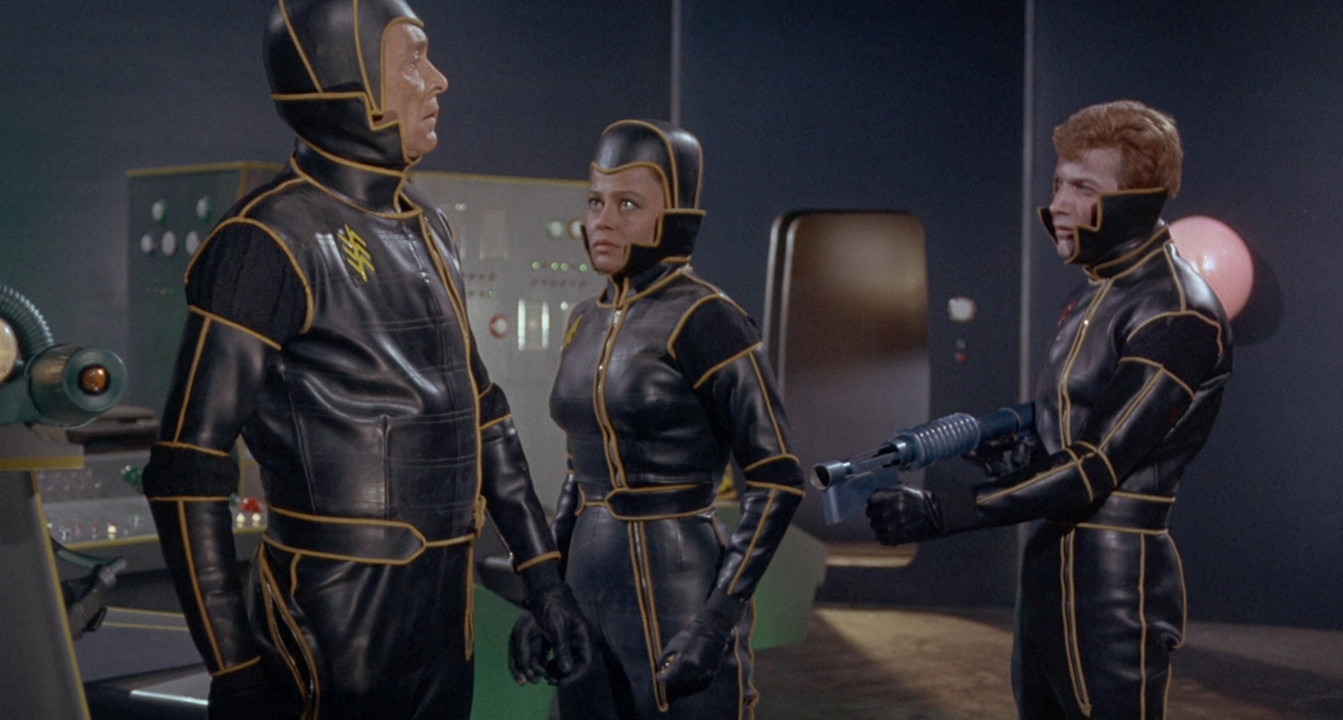
It’s got to be humiliating to be caught by a dead guy.
It’s a neat movie, and I adore it, but I’m afraid it’s not very good. The dubbing is never great and is often downright silly. While there’s a lot of visual interest (the costumes and some of the set designs are nifty), there are many times in which it’s painfully apparent that you’re looking at cardboard with a lick of paint. If you like style over substance — and when it comes to Italian cinema, I most definitely do! — then it can be a rewarding view.
One more note: if you’re expecting vampires, you will be frustrated and potentially aggrieved. The vampires exist solely in the minds of whatever marketing team came up with the American title. The original name was the less inaccurate Terrore nello spazio, or Terror in Space. There are some corpses that walk around. They aren’t exactly zombies, but they certainly aren’t vampires. Thank the marketing team at AIP for the misleading title. So now you know.
Spiders 3D (2013)
Directed by Tibor Takács
Written by Joseph Farrugia, Tibor Takács, and Dustin Warburton
We start in space, with the title appearing against a starry background.
In space, no one can hear you sigh at the spinning title.
I don’t have a 3D set, but if the title hadn’t mentioned it I wouldn’t have known I was missing something. So, good going titles.
The camera pans until the Earth comes into view. Then we see our planet covered by a spider. As our view pulls back we see that it’s actually on a view port of an orbiting space station. From the dead astronaut and many loose spiders, we may assume that something went wrong. Further, the Cyrillic letters on a clipboard indicate it was a Russian vessel.
If you were thinking that a meteorite would strike the space station, I congratulate you! You’ve seen a movie before.
Meanwhile, in New York City, our hero arrives at a rail transit control hub. Patrick Muldoon (“Starship Troopers”, “Days of Our Lives”) plays Jason, who seems to be some kind of district chief. One of the workers hands him an iPod. This is a gift purchased on Jason’s behalf for some young girl. Like a lot in this film, the details are murky.
When there’s a problem at the Noble Street subway station, transit worker Jimmy goes into the tunnel to investigate. He finds that something has penetrated the tunnel, but his experience fighting in Iraq tells him it wasn’t a bomb. Homeland Security is called anyway. Given that Jimmy fails to notice the large blue spider that crawls out his pants seconds after he’s bitten, it’s probably wise not to trust his observations.
Jason breaks contact with Jimmy to watch a news report on the incident. It identifies the cause as debris from a Soviet satellite launched in the 1980s. Jason decides to see the damage for himself, so he heads out. He tries to reach Jimmy again but gets no response. This is hardly surprising, as Jimmy has passed out from the toxins in his system and landed on the infamous third rail.
Jason pulls up to a subway entrance in a New York Transit van. A body is being loaded into an ambulance, and our hero asks callously if it was a jumper. A woman some kind of uniform who seems to know Jason informs him that it’s Jimmy. She is Rachel, played by Christa Campbell (“Mansquito”, “Day of the Dead”), and we’ll find out more about her later.
Down in the tunnel people in hazmat suits inspect the area with various equipment. They declare it’s free of radiation, and a bunch of officials enter — Jason and Rachel included. A Dr. Darnoff identifies a piece of wreckage as a disposal unit from the satellite. Homeland Security is satisfied, Rachel says the Health Department is not. ‘Waste’ sounds like something potentially hazardous. While everyone bickers over who’s paying for what and when the subway can re-open, nobody notices rats fleeing the area.
Later that night Rachel arrives at a Chinese restaurant where her daughter Emily has been waiting with (presumably) a babysitter, who promptly leaves after being paid. Rachel tells Emily that her father means well, and from their mention of his subway and the presence of gifts we can start to infer that Jason and Rachel might be more than friends.
Jason stops at a hospital, where a Dr. Stella takes him to the morgue. There she confirms that Jimmy died of electrocution. What’s interesting is what hadn’t killed him; she found the spider bite and worse — marble-sized eggs in his abdomen! Jason asks to take them to City Health, which probably violates all manner of procedures, but Stella readily hands them over.
Jason’s next stop is Rachel’s apartment. He gives Emily the iPod, and she happily flees the scene. Jason hands the eggs to Rachel, and she gives him divorce papers. At least we finally understand their relationship.
From here the plot spins into the well-worn patterns of government conspiracy, re-uniting family, and experiments gone wildly out of control. The area around the Noble Street station becomes overrun with spiders the size of people, and it’s up to Jason to stop the enormous queen.
It’s not what you’d call a good movie, but it’s largely entertaining and has some really nice touches. Some of the minor characters actually have significant plot beats, and even the soldiers that enforce the quarantine are shown to be people with their own motivations. The thinnest characterization is Colonel Jenkins, played by veteran actor William Hope (“Aliens”). He’s the villain of the piece, responsible for many of the named-character deaths and difficulties, but the script doesn’t give him any motivation or personality other than the face of pitiless government.
The true joy of this film is the spiders themselves. They’re goofy looking and abundant, growing to the size of a horse in roughly a single day. Then there’s the queen… But first let’s talk origin.
We’re told by Dr. Darnoff that the soviet scientists had tried to splice alien genes into several different animals but that only the attempt with spiders had succeeded. Why would they do this? To produce military-grade silk for making armor. The colonel, of course, wants to drop spider eggs on enemies.
All of which begs several grade-school level questions.
1. Why would you cross anything potentially dangerous with a spider? You know what you cross spiders with? Tomatoes! Tomatoes never killed anybody.1
2. When did the silk plan enter the picture? Did the dead aliens have a gold-plated record that told of the wondrously strong silk their genes produced? It seems more like something the scientists made up when they were caught making alien-hybrid spiders.
3. Why did they stay relatively small in the space station? Granted it’s not like there was a lot of food, but it’s not as though they spent enough time eating to grow as big as they did so quickly on Earth.
4. What did they eat on the space station? A cosmonaut, obviously. But then what? The station was essentially abandoned for decades.
5. After the giant spiders wipe out your enemy, how do you get rid of them? The Orkin army?
Ultimately, it doesn’t matter. All you need to know is that all mysteries are explained by “alien
DNA” and that the queen is the size of a nice house in the suburbs.

One of these two is very smart. The other splices alien DNA into spiders.
While it’s not CGI on the level of “Jurassic Park” or Peter Jackson’s “King Kong”, the effects in this are a darn sight better than the typical fare in modern spider movies. For the most part the spiders interact reasonably well with the environment, and the design is fun. They have big humanoid eyes and multiple sets of jaws. Best of all, the queen shows accumulated damage from all of the bullets and general artillery that have hit it. When so many details are omitted, glossed over, or otherwise left to the viewers’ imagination, this demonstrates that genuine care went into the production.
Overall I found “Spiders” entertaining and a touch above the average monster flick. Despite a run-of-the-mill plot and some standard failings, it’s a movie that I can go back to again and again.
And maybe one day I’ll manage to see it in 3D!
RANDOM THOUGHTS
Patrick Muldoon is no stranger to fighting giant spiders. Even if you don’t count “Starship Troopers”, he starred in the direct to TV “Ice Spiders”.
I actually appreciate that the script leaves Jason and Rachel’s relationship undefined for so long. It seems more natural that they don’t talk about it all the time.
Of all the people in the film, I feel sorriest for the babysitter. It sucks for all the victims, but here’s a girl who was just picking up some spare cash, and she gets put in quarantine and killed almost as an afterthought.
FOOTNOTES
1. “Attack of the Killer Tomatoes” doesn’t count.
The Black Scorpion (1957)
Written by David Duncan and Robert Blees
Directed by Edward Ludwig
Giant critters were a staple of the drive-in fare of the late 1950s. “Tarantula”, “Them!”, “The Beginning of the End”, and so many others — the genre consisted largely of forced perspective filming, footage of animals super-imposed over actors, and the occasional puppet. In these standard techniques “The Black Scorpion” falls squarely on its drooling face. Where it excels is in the superb use of stop motion animation for the majority of its creature effects.
The film opens on stock clips of volcanos and earthquakes as a narrator ponderously explains the setup. He tells us that before forces that are “the most violent of modern times”, the people of Mexico can only pray. (Cue prayer footage.) A new volcano is formed, he tells us, and it grows 9000 feet in only a few days!
No one will be seated during the rather bland opening credits.
When the opening credits end, we see a jeep hauling a small trailer through the wasted landscape. The vehicle stops, and our male leads climb out to drop some exposition. Hank Scott is an American, visiting Mexico through the courtesy of Professor Artur Ramos. They are geologists who’ve driven through the destruction for three days to reach the new volcano. Amid all the waste lies a literal sign of life: a road marker which (if somehow still close to its standing position) indicates that they are 117K from Mexico City1 and only 12K from San Lorenzo. There are also indications that at least one other vehicle has been through here recently.
Continuing their journey, Ramos and Scott come upon workers repairing phone lines. These men affirm that San Lorenzo is near but haven’t heard how the town has fared in the wake of the disaster. The bridges might be out, they warn. A police car that headed that way never came back, though, so it’s possible that the route is clear2. The geologists thank them and continue their thrill-a-minute drive.
They locate the police car in a tiny deserted village. The car, and pretty much everything nearby, has been demolished. They can’t tell by what, but it may be related to that buzzing sound… Scott and Ramos find one survivor (a baby) and one victim (the police officer). They use the police radio to call in their discoveries then continue on to San Lorenzo, where military assistance should arrive the following day.
A crowd greets them in San Lorenzo, and after handing the baby to a nearby woman our heroes join Father Delgado for some dinner and expository dialog. It seems that in the aftermath of the eruption there have been other disappearances and unusual destruction. When victims have been found, their bodies are bloodless and their faces frozen in fear. Largely fueled by rumors from local caballeros, the masses believe it to be the work of a demon bull3.
Of course, none of this dissuades our intrepid duo from heading ever closer into danger. The following day, against the advice of Major Corsio (head of the newly arrived army unit), our action geologists continue driving toward the new volcano. They meet up with Teresa Alvarez, owner of the Alvarez ranch (whose cattle herders have fled, fearing the demon bull). Ramos discovers a sheet of unearthed shale, and after a lot more exposition and a meal the plot finally lurches begins in lugubrious earnest.
If you think I didn’t care for this movie, you’re partially correct. The pacing is atrocious, the plot meandering, and the direction tepid. I’ve seen far worse, but on a scale of “Unwatchable” to “Play It Again Now!” I would give it an honest “Well I’ve Seen That Now”… except. Ah, except for the wonderful, animated scenes of giant scorpions and other critters!
The great Willis H. O’Brien (“King Kong”, 1933) designed and supervised the effects, and his protegé Peter Peterson handled the actual animation. There are a few major set pieces, and they are a joy to behold: the lost underground world, the train tracks, and the stadium. The scenes at the train and stadium feature a lot of giant scorpion on vehicle violence and even the grisly demise of a few animated people. They’re a fun treat for fans of stop motion animation.
The reason I’m writing about this movie is what happens deep underground. Amid all the seismic activity of the eruption, an entrance opened on a world that had been sealed underground since pre-history — an enormous set of caverns in which monsters live brutal lives. It’s down here that Juanito meets a trap-door spider roughly the size of a brown bear.4

Wait. Six legs? We found the spider that everyone in “Camel Spiders” kept talking about!
“Wait”, you cry. “Who’s Juanito?”
Remember Teresa Alvarez, whose caballeros believed in a demon bull? Juanito is a servant boy on her ranch, and it is truly unfortunate that he stuck around. Whenever he’s told to stay put, he immediately sneaks off to run straight toward the scorpions. It’s amazing to me that nobody ever thought to tie Juanito down.
Naturally, when Ramos and Scott decide to descend into the crater via a lowered cage, Juanito tags along. This, immediately after being discovered hiding in the jeep, whereupon he had once again been told to stay the hell put. Somehow, two scientists fail to detect the child during a twenty-minute descent in a cage the size of a closet. Once they reach the bottom, the men tramp off, leaving Juanito to find some danger — which he does with a quickness!
Juanito leaves the safety of the cage and wanders directly to the lair of a big damn spider. This kid is so determined to die that he actually tugs at the spider’s trap door! Naturally, Ramos and Scott must rush over to save him. Mercifully the action soon moves to Mexico City, and the plot is no longer propelled by Juanito’s self-destructive urges.
This spider is an odd one. For one thing, it only has six legs. That’s assuming that the front appendages with pincers are pedipalps, which they would be on a scorpion. Additionally it doesn’t exactly leap out of its tunnel, which sadly allows Juanito plenty of time to get running. If we’re to assume any attempt at historical accuracy it could be that this arachnid is from a lost family of the sub-order Mesothelae, but it seems unlikely that much thought went into it.
With limited time and budget O’Brien and Peterson put the main effort into the scorpion models, which are excellent. The spider and another creature (a sort of worm with arms) are left over from O’Brien’s work on King Kong! They were two of the monsters at the bottom of a ravine, in one of the most famous cut scenes in the history of cinema. It’s neat that they were pressed into service again a quarter of a century later, but their design esthetic does not sit well alongside the more modern work.
Budget is the enemy of many films, but its lack is painfully visible here. The super-imposing process of the 1950s was labor intensive, and there was just too much to do. The result is a number of scenes that show the silhouette of a scorpion over running crowds. This is the matte over which the animation was to be placed, and it doesn’t look good on its own.
The other thing that looks bad is the scorpion head used for close-up shots. O’Brien supposedly supervised all of the effects, but he must have been looking elsewhere when this puppet was made. All of the realism and artistry of the animation models is completely absent here. It has a goofy, gaping maw that’s constantly drooling and googly eyes, and it looks nothing like the creatures taking apart trains and pulling helicopters out of the sky.
Hampered by a meandering script and budgetary constraints, “The Black Scorpion” nonetheless marks a high-point in arachnid cinematic effects. Far superior to most puppets and better than low-budget CGI, it’s a shame they weren’t part of a worthier movie.
FOOTNOTES
1. It is actually far from ludicrous to imagine a volcano appearing so near Mexico City. The city lies in the path of the Trans-Mexican Volcanic Belt, which forms a roughly latitudinal line across the country. There is even an active volcano only 40-some miles away. I will not speculate as to the odds of the spontaneous generation of such a massive new volcano in the region, but I think that the side effects of such an event would be catastrophic enough without adding giant prehistoric scorpions into the equation.
2. Whenever a character thinks that someone never returning is a good sign, I can only marvel at their innocence. If I go two hours without hearing from someone, I assume they’ve been eaten by dingoes.
3. Sadly, the legend of the demon bull is largely glossed over. It seemed far more plausible than the actual danger presented.
4. Nope. I’m not invoking the scorpions-are-arachnids clause to justify including this movie in the Big Damn Spider canon, although scorpions are way closer to spiders than whatever the heck this creature is. It only has 6 legs, so maybe it’s an escapee from “Camel Spiders”.
Village of the Giants Mini Lobby Card

Mini lobby card for “Village of the Giants”.
Have Rocket — Will Travel (1959)
Written by Raphael Hayes
Directed by David Lowell Rich
Writing a review of The Three Stooges is an interesting challenge. Narrative coherence is irrelevant when the story only exists to provide an excuse for eye-gouging and set-wrecking. Dialogue doesn’t need to be more eloquent than an angry “Why you!” I’m not even certain that normal standards of acting apply. But, since there’s a giant spider in their film “Have Rocket — Will Travel”, I’m prepared to work through all that.
Let’s start with the title. If it doesn’t sound familiar, it should. Stooge titles tend to be plays on expressions or titles of other works. In this case, it’s a reference to the popular western show “Have Gun — Will Travel” that began airing in 1957 — two years before the release of this film. There’s no other connection to the show, but the reference is reinforced with a title song that is sung by the Stooges over the opening credits.
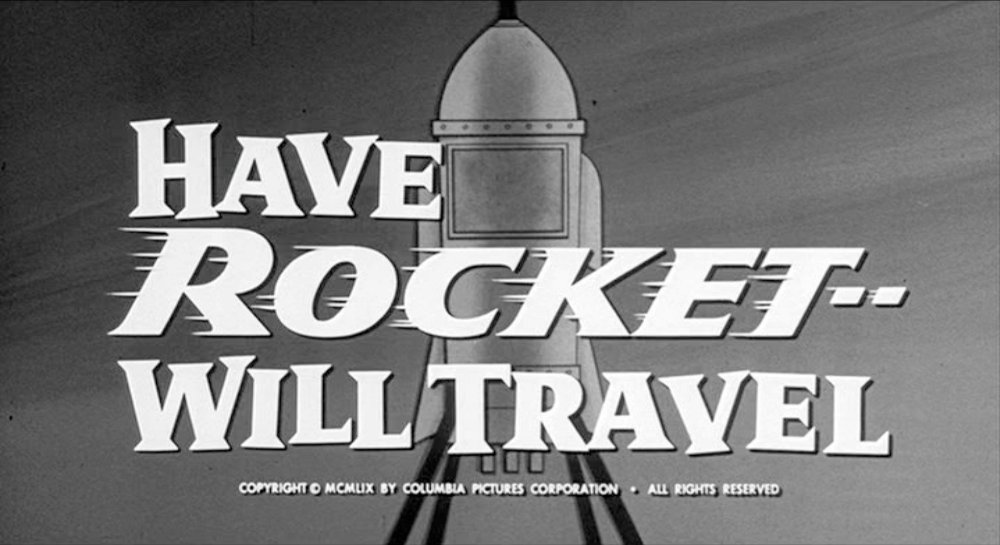
I’ll watch your movie. Just please stop singing.
Speaking of credits, the Stooge line-up for this outing is Moe Howard, Larry Fine, and Joe DeRita (Curly-Joe). Curly-Joe gets some guff for being the second substitute Curly, who himself replaced Shemp. (Being the third Stooge was seemingly as fatal as drumming for Spinal Tap1.) Curly-Joe does a decent enough reproduction of Curly’s routines, and he provides some genuinely entertaining moments, so I’m not going to dump on the guy. I think he just suffered from being cast at a time when the Stooges were just re-enacting stale clones of their previous routines.
Speaking of clones, I should give a quick rundown of how the set pieces stitch together.
We start with a rocket test by the National Space Foundation (NSF). This is their 4th launch, and there’s a monkey on board — because I guess in the 1950s it was mandatory to put a monkey in space movies. The test fails, and the rocket crashes. The Stooges, who are the maintenance men on the base, are put in charge of guarding the fallen rocket. This leads to the Stooges chasing the monkey all over the rocket until it accidentally rights itself.
Here’s where things get unnecessarily complicated. Dr. Ingrid Naarveg, lead (and apparently only) scientist at the NSF, is nice to the Stooges. They see her as a daughter and want to help her keep the project alive. In order to do that she needs to find a better fuel. Stooges to the rescue! In the course of a night they brew up a more powerful fuel (the secret is sugar!) and load it into the rocket.
The head of the NSF, angered by the Stooge’s nocturnal activities (and the inevitable ancillary destruction), manages to chase them into the rocket and launch it into space. Our promised space travel is under way at last!
Once on Venus, the Stooges encounter a talking unicorn, a giant spider, and a tyrannical robot (that makes clones of them because it likes their form). They also sing more of the title song. On their return, the Stooges are hailed as heroes. They leave the clones in their place and run off with the talking unicorn to sing more of that infernal song.
You don’t have to be a Stooge fan to find their rise to fame predictable. It’s a given in American comedy that experts are fools and fools are experts. Opposites attract, experts are unmasked, the simple are rewarded, and there’s probably a wedding.
In this case, the wedding is between Dr. Naarveg and the base psychiatrist. Barely in the movie, their roles consisted primarily of 1) Dr. Naarveg providing unnecessary motivation to the Stooges and 2) the psychiatrist repeatedly telling her that she’ll only find happiness by marrying him and abandoning her career. He finally convinces her with a sudden agarring2. It was, after all, 1959, and while a comedy could make a woman the lead scientist in a space program it would also make certain to put her back in her place by the end.
Additionally, while the pompous head of the NSF gets a humiliating take-down, remember that three bumbling clods managed in one night to produce the breakthrough in fuel that eluded Dr. Naarveg. That’s got to hurt.
Some of the Stooge routines were painful, too. Interestingly, it wasn’t due to the performances. A classic routine is a classic routine, and old and fat as they are the Stooges are skilled physical comedians. I place the blame on the director, David Lowell Rich. Rich was a workman director, the bulk of whose career was spent in TV. B-Movie fans may have seen the TV movie “Satan’s School for Girls” (an Aaron Spelling production), but his most remembered work is possibly “The Concorde — Airport ’79”, the final nail in the coffin for the Airport franchise.
It’s clear that Rich and cinematographer Ray Cory had no idea how to film the Stooges. These are guys who mastered their craft on the stage, and when they went to film they largely kept that full view ethos. They fill the screen with broad movements and large messes. Here, the camera often slows things down, breaking the frenzy of action into careful and discrete pieces. It just doesn’t work well, and (as in “Yellowbeard” and “The Villain”) the humor doesn’t survive filming.
That isn’t to say that nothing works. A few scenes work very well, mostly because the close shots are mixed well with larger fields of chaos. Two of these are standard Stooge set pieces: the bedroom and the ballroom. The first shows the unusual morning routine of the Stooges, and everyone wrestles with appliances, clothing, and furniture. The second, of course, winds up in a pie fight.
The society ball is where Curly-Joe shines. While the others are dancing enthusiastically with their new admirers, Curly-Joe just wants a piece of cake. His doomed effort sends the soirée flying face-first into its pie-filled fate, while he calmly accepts what is left for him. It’s a sequence that’s both entertaining and oddly reassuring.
The other fun scene was the invention of the rocket fuel. Dr. Naarveg’s lab becomes a kitchen as the Stooges start mixing ingredients in a large vat. Much of the ensuing business is familiar, but it’s less pat than the other scenes. There’s something delightful about Larry intently brewing coffee over a bunsen burner, like the Walter White of caffeinated beverages. Of course, not even Larry tried to cook with the flame-throwing giant spider.
That’s right: flame-throwing giant spider.

Pretty much my worst nightmare.
Almost immediately after disembarking on Venus, the Stooges are threatened by a giant tarantula (courtesy of forced perspective shots and editing). Then the film stops, and a light beam is drawn in, emanating from the tarantula. Flame pursues the Stooges as they run away.
I’d like to tell you that there’s no real reason for there to be a flame-throwing giant spider on Venus. The crazy part is that there is a terribly convoluted reason.
You see, despite all the nonsense about making fuel, the rocket is launched by igniting a lengthy fuse. It’s a strange plot point, requiring the base commander to accidentally (and angrily) light the fuse to send the Stooges on their voyage. Mysteriously, there is some fuse left for the return trip, and it’s up to the flame-throwing giant spider to reignite it.
I fault screenwriter Raphael Hayes for the clumsy movement of the script, but I have to admire his fierce devotion to the fuse gag — a device that backed him so far into a narrative corner that only a flame-throwing giant spider could get him out of it.
RANDOM THOUGHTS
- While rocketing to Venus, the Stooges turn on the communication console and get a TV Western. They change the channel and tune in the NSF lab, where Dr. Naarveg and her suitor are engaged in a dramatic scene in the style of a soap opera. I really liked the thought of the console having been installed so the monkey could watch his favorite shows.
- The robot is delightfully ill-constructed. It looks like the prop guy just stuck a bunch of crap on a box until he ran out.
- The Stooge snore gag works every time.
- There’s a keyhole at the base of the rocket. I find that charming, for some reason.
FOOTNOTES
1. To be fair, Joe Besser didn’t die “in office”, as it were.
2. agar, v.t. to kiss the bejeesus out of a co-star. Named for John Agar, the grand master of the technique.
 Web of the Big Damn Spider
