
The House in Nightmare Park (1973)

Directed by Peter Sykes
Written by Clive Exton and Terry Nation
Starring Frankie Howerd, Ray Milland, Hugh Burden, Kenneth Griffith, and Rosalie Crutchley
The Legend of the House on the Left at the End of the Lane in Nightmare Park.
There are times in which I believe that I don’t understand humor. Watching Jim Carrey and Adam Sandler rise to fame, I nearly became convinced that I didn’t. I do enjoy comedies, but I tend not to risk watching them unless I’ve heard good things from people I trust. A bad action or horror film can be fun in their own ways, but I find bad comedies excruciating. Being funny is the whole point, so when I can’t laugh with one I can’t enjoy it at all. To be honest, there are two exceptions to that general rule, and both are due to my affection for the soundtracks. The scores by The Kinks and Herb Alpert & the Tijuana Brass make the movies Percy and Casino Royale, respectively, worthwhile for me. For the “old, dark house” spoof The House in Nightmare Park I clung desperately to my adoration of Ray Milland, and that mostly saw me through.
The Grapes of Death (1978)

aka Les raisins de la mort
Directed by Jean Rollin
Written by Jean Rollin, Jean-Pierre Bouyxou, and Christian Meunier
Starring Marie-Georges Pascal, Félix Marten, Serge Marquand, and Mirella Rancelot

Administering the experimental pesticide.
The word “zombie” has been applied to so many things that it’s all but meaningless as a descriptor. Some are brought back from death, some are still alive. They could be under mental domination, operating on instinct, or possessed of full intellectual faculties. It may be spread as an infection, be the result of contamination, or achieved through hypnosis. Ravenous ghouls, mindless slaves, enraged masses: all zombies. About the only certainty in the term is that it implies a removal from normal society.
Frankenstein Must Be Destroyed (1969)

Directed by Terence Fisher
Written by Bert Batt and Anthony Nelson Keys
Starring Peter Cushing, Veronica Carlson, Freddie Jones, Simon Ward, Thorley Walters, Maxine Audley, and George Pravda
Incontrovertible statement.
Peter Cushing starred as Baron Frankenstein in six Hammer films, which is an awful lot of appearances as the same character. You might expect that as the series went on he’d start phoning in his performances, but if so then you don’t know Peter Cushing. Not only was he a consummate professional, but Frankenstein Must Be Destroyed — the fifth in the series — is 98% of his best turn as the relentless Baron.
Escape to Witch Mountain (1975)

Directed by John Hough
Written by Robert M. Young
Based on the book by Alexander Key
Starring Eddie Albert, Ray Milland, Donald Pleasence, Kim Richards, Ike Eisenmann, and Denver Pyle

The title animation makes the dogs seem like they’ll be important.
If you asked me who my favorite child actor at Disney was when I was growing up, I’d say Jodie Foster. Her hidden-treasure movie Candleshoe lodged in my brain and never left. But if for some reason you’d excluded Foster from the choices, I’d definitely give you a give you two answers: Kim Richards and Ike Eisenmann. They seemed to be everywhere, and most importantly they were Tia and Tony Malone: the Witch Mountain kids.
Doctor Mordrid (1992)
Directed by Albert and Charles Band
Written by Charles Band and C. Courtney Joyner
Starring Jeffrey Combs, Yvette Nipar, Jay Acovone, Keith Coulouris, and Brian Thompson

Doctor Mordrid’s occult library.
Remember being a kid. Maybe you liked chocolate bars. Perhaps it was gum drops. Think back to when you first discovered that you could have so much of it that it stopped tasting great. Did you keep going? Did you have so much that you got a stomach ache? Did you get sick? For me, watching Doctor Mordrid was a lot like that.
Cave-In! (1983)

Directed by Georg Fenady
Written by Norman Katkov
Starring Dennis Cole, Susan Sullivan, Leslie Nielsen, Julie Sommars, Ray Milland, Sheila Larken, and James Olson

There is no question what this movie will be about.
Irwin Allen was the legendary producer behind Voyage to the Bottom of the Sea (film and show), The Poseidon Adventure, The Towering Inferno, and the shows Lost in Space, The Time Tunnel, and Land of the Giants. He also let this made-for-TV movie happen, which is just the sort of thing that’s bound to turn up eventually on a lengthy CV.
Brain Dead (1990)

Directed by Adam Simon
Written by Charles Beaumont and Adam Simon
Starring Bill Pullman, Bill Paxton, Bud Cort, Nicholas Pryor, Patricia Charbonneau, and George Kennedy
The title is the only thing about the movie that’s simple.
In 1990, theater-goers were astonished by the multi-layered, complex thriller Jacob’s Ladder. The big-budget film, starring Tim Robbins as a Vietnam War veteran whose life was collapsing in a Kafkaesque spiral of paranoia and hallucinations, quickly built a small but loyal following and influenced video games (Silent Hill), TV (American Horror Story: Asylum), and other films (The Sixth Sense, arguably included). Ten months earlier, Brain Dead had come out and quickly sunken to the murky depths of cult cinema.
The Attic (1980)
Directed by George Edwards and Gary Graver
Written by Tony Crechales and George Edwards
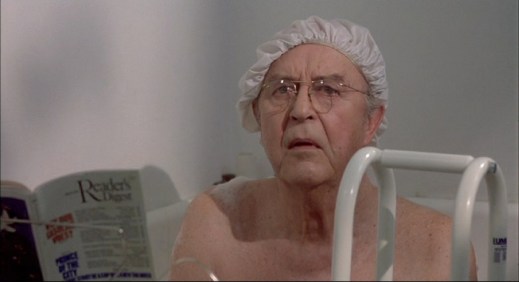
Starring Carrie Snodgress, Ray Milland, Ruth Cox, Rosemary Murphy

THE ATTIC: the terrifying story of a librarian who loves monkeys.
The 1973 film The Killing Way presented the gruesome murders of women that follow the release of a man convicted of rape. I’ve never seen it, but that’s okay. It’s irrelevant for this review except for its connection to The Attic. You see, the main characters of The Attic — Louise Elmore and her father Wendell — were side characters in The Killing Way, played by Luana Anders and Peter Brocco. Writers Tony Crechales and George Edwards decided to reuse them here, making it not quite a sequel but at the least a shared universe. Fortunately, this loose connection means that you can enjoy The Attic without having seen The Killing Way.
The Spider Labyrinth (1988)

Directed by Gianfranco Giagni
Written by Riccardo Aragno, Tonino Cervi, Cesare Frugoni, and Gianfranco Manfredi
Starring Roland Wybenga, Paolo Rinaldi, Margareta von Krauss, and Claudia Muzi

Spiders sold separately.
There are certain things I just know I have to watch. Giant spider movies, naturally. Italian horror is another favorite. I can’t say no to noir, especially the sort where investigation leads to doom. Anything with Ray Milland in it. So when I learned that The Spider Labyrinth was an Italian horror-noir about a spider cult, I nearly fainted with joy. Good thing Milland wasn’t in it!
The 5,000 Fingers of Dr. T. (1953)

Directed by Roy Rowland
Written by Dr. Seuss and Alan Scott
Starring Mary Healy, Hans Conried, Tommy Rettig, and Peter Lind Hayes
I hoped he actually had a freakish quantity of digits.
Dr. Seuss (Theodor Geisel) is a treasured part of our cultural consciousness. He wrote and drew seemingly hundreds of books for children, taking them through basic language lessons and whimsical diversions to allegorical fables of tolerance and equality. Say “one fish, two fish” to someone raised with English as a first language, and they’ll probably reply immediately with “red fish, blue fish”. (I would also believe this to be true for the speakers of the dozens of languages into which his books have been translated.) Seussisms are a shorthand language that we reference freely in the certainty of being understood. Even if someone doesn’t instantly recognize the word sneech, within five words of explanation they remember the story of the sneeches having stars placed on and then removed from their bellies in order to appear superior to each other. What most have forgotten, if they ever knew of it at all, was that the first live-action Seuss film was The 5,000 Fingers of Dr. T.
 Web of the Big Damn Spider
