
The Asphyx (1973)


Diected by Peter Newbrook
Written by Brian Comport from a story by Christina Beers and Laurence Beers
Starring Robert Stephens, Robert Powell, Jane Lapotaire, and Alex Scott
According to the movie, an asphyx is a creature of Greek legend that appears to those about to die in order end its own torment. This is glossed over rather quickly, as the “reality” is somewhat more complex. The true reality, of course, is that there’s no such recorded myth, which is a shame. School children would have been delighted to discover a creature whose name is pronounced like a repair to the posterior.
The Asphyx centers on the activities of Sir Hugo Cunningham (Robert Stephens), who has two preoccupations: the paranormal and the newly developed art of photography. Sir Hugo is quite inventive, creating his own lighting equipment with luminous crystals and dabbling in a slide-based motion camera with accompanying projector. His interests collide when photographs of people at the moment of death (taken by himself and two others) reveal a dark smudge near the body.
He and his colleague, Sir Edward Barrett (Alex Scott, who you may recognize from his roles in Twins of Evil and The Abominable Dr. Phibes), believe these photographs show the departure of the soul. When Sir Edward requests pictures of a hanging to use in efforts to ban executions, Sir Hugo decides to use the opportunity to further test his filming techniques. The light is dim, so he turns on his blue light. To everyone’s horror a hideous creature appears in the light. Even worse, the hanged man doesn’t die. Appalled, Sir Hugo shuts everything down in order to flee. The moment his light is turned off, the strange apparition vanishes and the convict dies.

“Iiiiiiii ain’t got no… booody!”
Here at length is the premise, and it’s a corker! In effect, The Asphyx is an exploration of how Frankenstein might have turned out if the Baron had gone into mad engineering instead of mad surgery. Their goals are identical: to conquer death. Both men are motivated by the tragic loss of loved ones, and both lose everything in their struggle against the inevitable. Only their methods differ. While Baron Frankenstein sought the medical spark of life, Sir Hugo pursues the spiritual cause of death. Death only comes from the arrival of an individual’s asphyx, so by trapping their asphyx a person becomes functionally immortal.
It’s a slow-paced but engaging story, filled with melodrama and the lamentable tragedies of hubris. Also lamentable are the effects, some of which are distractingly bad (I’m looking at you, Old Age Makeup). The plot depends on the asphyx, which looks like a muppet of a Fiji mermaid. They try to hide it in a fluttering projection, but it’s still just a sad puppet with floppy arms.
On the whole, I like this one a lot. The concept is neat, and there’s a terrific comeuppance scene to show Sir Hugo the error of his ways. It’s far from perfect — and there are some horrible contrivances — but it’s a good example of the horror of thought, which has largely given way now to the horror of viscera. I enjoy a good gut-slitting, but the movies that stay with me tend to be the ones that plant ideas in my head.
Summer School (2006)
Directed by Lance Hendrickson, Troy McCall, Mike P. Nelson, Steven Rhoden, and Ben Trandem
Written by Lance Hendrickson, Mike P. Nelson, Steven Rhoden, Pa Chia Thao, and Ben Trandem
Starring Simon Wallace, Amy Cocchiarella, Tony D. Czech, Lance Hendrickson, Troy McCall, and Mike P. Nelson
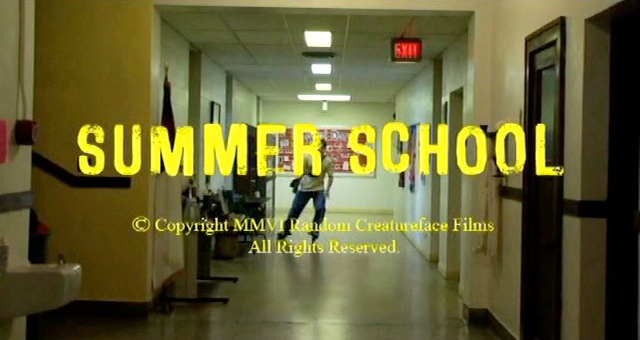
I do appreciate the 1970s style title.
The Devil Rides Out – Promotional Image

Christopher Lee hosts a protective sleepover, in “The Devil Rides Out”.
Krull – Promotional Image 9
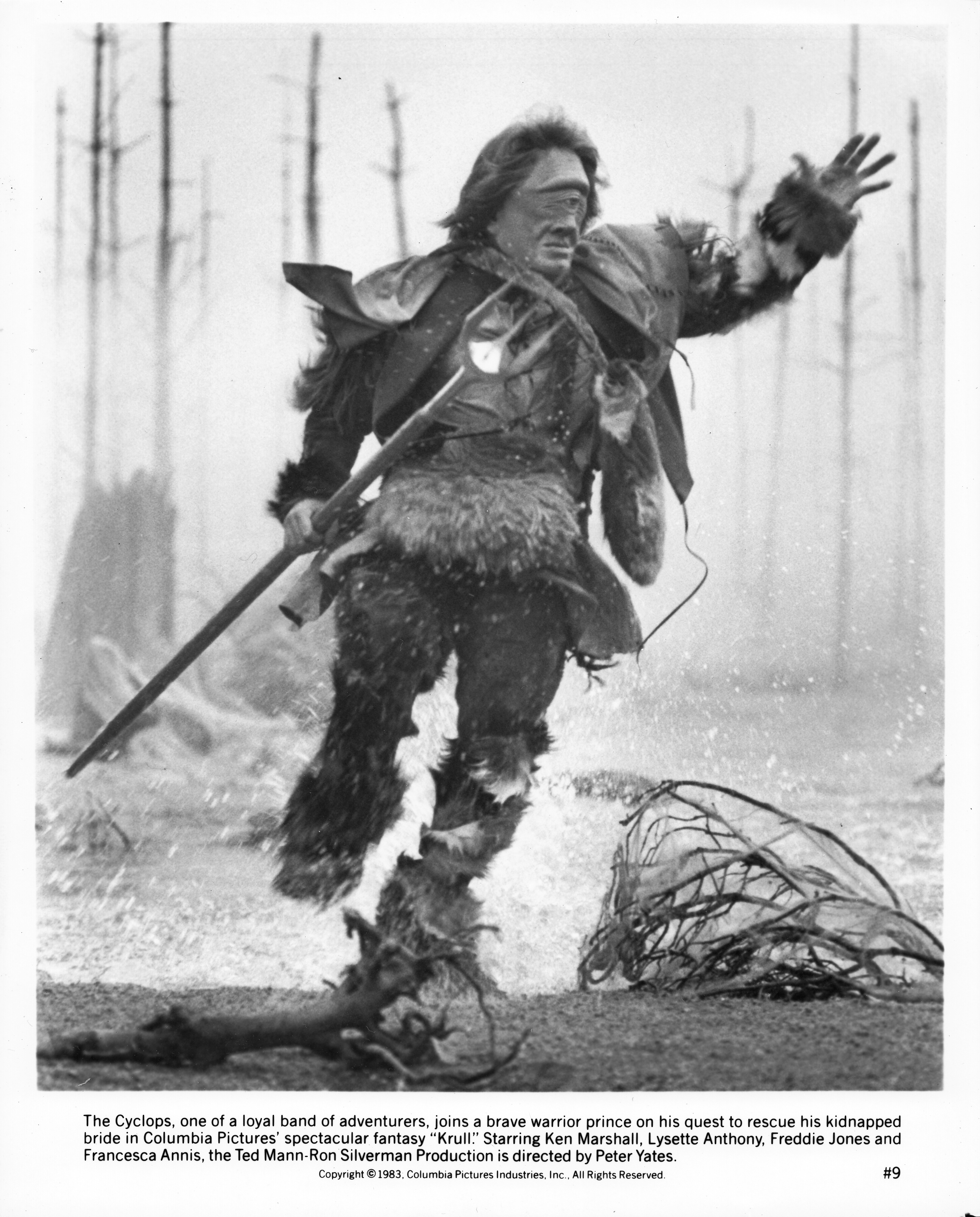 Bernard Bresslaw, as the Cyclops.
Krull – Promotional Image 14
 The Beast would like to talk to someone about his makeup.
The Lost World (1960) – Promotional Still

“Look, just because you live around here, that doesn’t mean you’d know there are big damn spiders about.”
Cat-Women of the Moon – Promotional Image

You generally don’t want to give away your best special effects in the promotional material, so this spider got shown a lot.
Tarantula – Promotional Image

Striped pajamas, the official night cloths of victims of scientific research.
Krull – Promotional Image 10

Francesca Annis as the Widow of the Web.
The Devil Rides Out (1968)
Directed by Terence Fisher
Written by Richard Matheson, from a novel by Dennis Wheatley
Hammer Films dominated horror in the 1960s, with their stylish Gothic approach and stable of charismatic actors. Their Dracula and Frankenstein franchises were particularly lucrative, and while it would be stretching things to say that they could do no wrong during this period, it’s reasonable to expect a certain high degree of quality. The stakes get raised when considering the creative team behind The Devil Rides Out.

The opening titles are a wash of swirling smoke and green symbols of the occult.
Terence Fisher had directed several of Hammer’s hits, including The Curse of Frankenstein, Horror of Dracula and The Hound of the Baskervilles. Richard Matheson had helped turn his own book I Am Legend into the famed movie The Last Man on Earth, starring Vincent Price. He’d written the screenplays for Roger Corman’s Poe adaptations The Raven, The Pit and the Pendulum, and Tales of Terror. Between them, Fisher and Matheson brought an impressive resume to the table.
Then there’s Dennis Wheatley, an English author whose writing influenced Ian Fleming. His first published novel, The Forbidden Territory (1933) featured the Duke de Richleau. The following year saw the release of both a movie version and the second in what would be an 11 book series of the Duke’s occult adventures, The Devil Rides Out. Still a best-selling author in the 1960s, it could be assumed that Wheatley’s works would have been familiar to British audiences for this adaptation.

“Please, this time — just listen to what I’m telling you!”
It’s clear that Matheson relied on this familiarity. Characters have relationships that are glossed over, as though unnecessary to explain. The Duke just happens to know everything about the occult, and his knowledge is explained with a terse comment about his studies. It feels like several scenes are missing, and in fact there are — an entire book’s worth! The result is a mixed bag. On the one hand, it’s kind of realistic that we don’t get a lot of context. People are busy fighting Satan and don’t have the time to re-establish their relationships. Yet it distances the viewer a bit as well. There’s a tight central group of characters, and we’re on the outside. It’s frankly a little off-putting.

The Eatons, with young Peggy hanging on Uncle Rex. They also call de Richleau uncle, so who knows if they’re even actually related to anybody?
Fortunately, the film stars Christopher Lee in the crucial role, here very slightly renamed as Duc de Richleau. Lee’s authoritative manner makes de Richleau seem more than capable of besting Lucifer at anything from magic to snooker, which somewhat mitigates the absence of back story. On the downside, he frequently leaves to conduct research, and nobody he knows can follow simple instructions. This allows the dastardly Mocata (played by the deliciously fiendish Charles Gray) to do pretty much anything he wants.
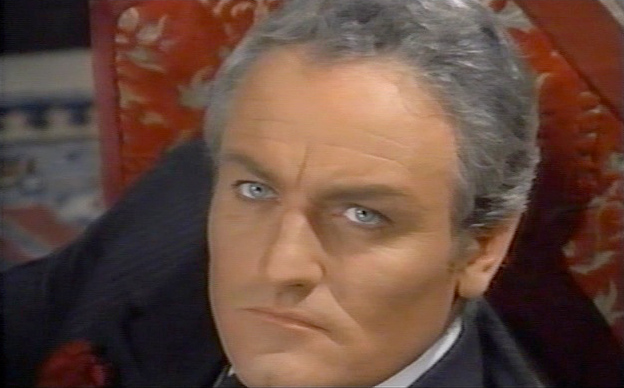
“I’m safe so long as I don’t run into de Richleau — or that damnable Bond!”
What Mocata wants is to add two members to his coven to bring their number up to the requisite 13. He’s accidentally selected Simon Aron (Patrick Mower), who de Richleau and his close friend Rex Van Ryn (Leon Greene) have sworn to watch over. The other recruit turns out to be the fetching Tanith Carlisle (Nike Arrighi), with whom Van Ryn falls madly in love. Aron and Carlisle’s minds are already under Mocata’s control, so there’s nothing for it but that de Richleau and Mocata battle for their souls. It’s all very much like a serial, with the villains and heroes dashing after each other fruitlessly until the climax.
So how does a giant spider figure into this movie? Simon is placed under the protection of de Richleau and the Eatons (a nice couple, related to somebody) inside of a magic circle. If they can prevent Mocata from claiming Simon overnight, he’ll be safe. The first gambit Mocata tries is to send a giant tarantula to prowl the edge of the circle. When that somehow fails to make anyone leave the protection of the circle, young Peggy Eaton enters the room for the spider to menace.

Duc de Richleau was renowned for his creative party games.
The approach chosen was a mixture of filming a tarantula on a miniature set and matting it in when it needed to be seen with the actors. This is a difficult trick for color film, and the complicating factors of the lighting in the room do not work in the effect’s favor. Nonetheless, it’s largely effective. In most of the sequences, it works well. The worst lighting problems occur when interacting with Peggy, when suddenly the tarantula is too bright. It could have come off as a game attempt if not for the inclusion of footage of the spider “rearing”. While tarantulas will rear up, it’s generally because they feel threatened. This one seems to be merely testing the glass wall in front of it. Much like the ants climbing into the air in Empire of the Ants, it re-engages disbelief with a quickness.

In Hell, spider squishes you!
Also quick is Mocata’s escalation of attacks, but that’s getting into spoiler territory. Let’s just say he jumps straight from “dare” to “triple-dog dare” in direct violation of the Queensbury rules. He’s sort of a jerk that way.
It’s a pretty neat movie. I understand why many people consider it to be one of Hammer’s best. Lee and Gray, though sharing only a few scenes, ground the film with the power of their palpably clashing wills. Although the effects are sometimes less than spectacular, the menace they serve to reflect is stronger than in most plots about Satanism. Partly, this is due to Mocata’s mental dominance over all but de Richleau, but really it’s how far Mocata is able and prepared to go for victory. I refer to the aforementioned untoward escalation. This isn’t your garden-variety cultist.

Even The Devil attends Mocata’s parties.
The biggest problem I think the movie has is its ending. Without revealing anything, I’ll just say that it doesn’t make immediate sense. Just as with his script for the excellent The Legend of Hell House (based on his own novel Hell House), Matheson underplays the critical part of the reveal. One or two more sentences from the Duc de Richleau would put it all together, but while the explanation we get is reasonable, it isn’t until ruminating over it much later that I came to accept it as more than a flimsy cheat. Maybe I’m inordinately dense, but while the conclusion makes perfect in a 1930s adventure sort of way, it just doesn’t seem direct enough for the style of story it is.
The film as a whole is enjoyable, and I recommend it particularly to fans of Hammer or of old-fashioned adventure films. Just stay on your toes and repeat to yourself “it all makes sense” until you understand why. Or, you know, understand it the first time. Whatever works.
 Web of the Big Damn Spider
