
Frankenstein Must Be Destroyed (1969)

Directed by Terence Fisher
Written by Bert Batt and Anthony Nelson Keys
Starring Peter Cushing, Veronica Carlson, Freddie Jones, Simon Ward, Thorley Walters, Maxine Audley, and George Pravda
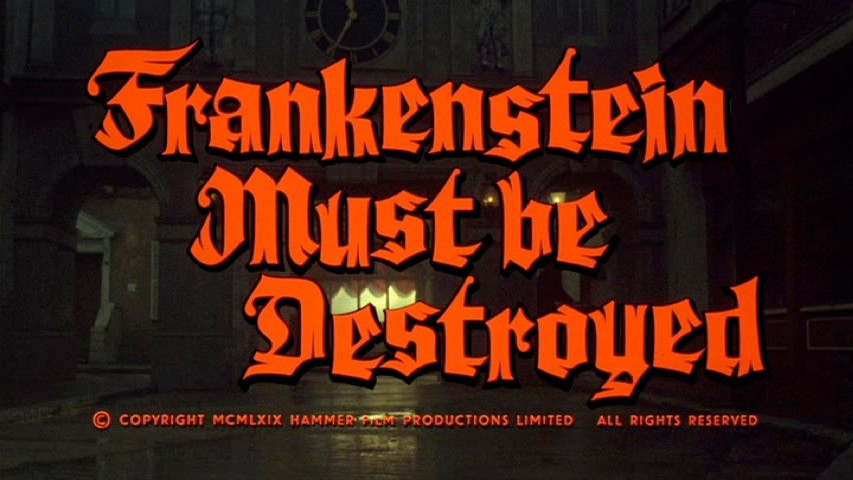
Incontrovertible statement.
Peter Cushing starred as Baron Frankenstein in six Hammer films, which is an awful lot of appearances as the same character. You might expect that as the series went on he’d start phoning in his performances, but if so then you don’t know Peter Cushing. Not only was he a consummate professional, but Frankenstein Must Be Destroyed — the fifth in the series — is 98% of his best turn as the relentless Baron.
Escape to Witch Mountain (1975)

Directed by John Hough
Written by Robert M. Young
Based on the book by Alexander Key
Starring Eddie Albert, Ray Milland, Donald Pleasence, Kim Richards, Ike Eisenmann, and Denver Pyle

The title animation makes the dogs seem like they’ll be important.
If you asked me who my favorite child actor at Disney was when I was growing up, I’d say Jodie Foster. Her hidden-treasure movie Candleshoe lodged in my brain and never left. But if for some reason you’d excluded Foster from the choices, I’d definitely give you a give you two answers: Kim Richards and Ike Eisenmann. They seemed to be everywhere, and most importantly they were Tia and Tony Malone: the Witch Mountain kids.
Doctor Mordrid (1992)
Directed by Albert and Charles Band
Written by Charles Band and C. Courtney Joyner
Starring Jeffrey Combs, Yvette Nipar, Jay Acovone, Keith Coulouris, and Brian Thompson

Doctor Mordrid’s occult library.
Remember being a kid. Maybe you liked chocolate bars. Perhaps it was gum drops. Think back to when you first discovered that you could have so much of it that it stopped tasting great. Did you keep going? Did you have so much that you got a stomach ache? Did you get sick? For me, watching Doctor Mordrid was a lot like that.
Cave-In! (1983)

Directed by Georg Fenady
Written by Norman Katkov
Starring Dennis Cole, Susan Sullivan, Leslie Nielsen, Julie Sommars, Ray Milland, Sheila Larken, and James Olson

There is no question what this movie will be about.
Irwin Allen was the legendary producer behind Voyage to the Bottom of the Sea (film and show), The Poseidon Adventure, The Towering Inferno, and the shows Lost in Space, The Time Tunnel, and Land of the Giants. He also let this made-for-TV movie happen, which is just the sort of thing that’s bound to turn up eventually on a lengthy CV.
Brain Dead (1990)

Directed by Adam Simon
Written by Charles Beaumont and Adam Simon
Starring Bill Pullman, Bill Paxton, Bud Cort, Nicholas Pryor, Patricia Charbonneau, and George Kennedy
The title is the only thing about the movie that’s simple.
In 1990, theater-goers were astonished by the multi-layered, complex thriller Jacob’s Ladder. The big-budget film, starring Tim Robbins as a Vietnam War veteran whose life was collapsing in a Kafkaesque spiral of paranoia and hallucinations, quickly built a small but loyal following and influenced video games (Silent Hill), TV (American Horror Story: Asylum), and other films (The Sixth Sense, arguably included). Ten months earlier, Brain Dead had come out and quickly sunken to the murky depths of cult cinema.
The Attic (1980)
Directed by George Edwards and Gary Graver
Written by Tony Crechales and George Edwards
Starring Carrie Snodgress, Ray Milland, Ruth Cox, Rosemary Murphy

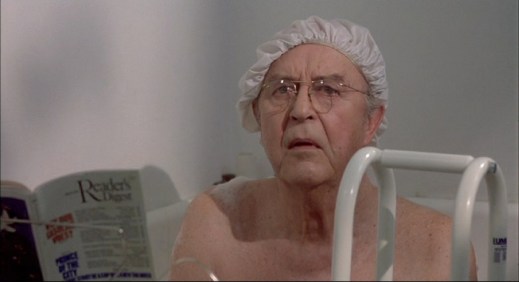
THE ATTIC: the terrifying story of a librarian who loves monkeys.
The 1973 film The Killing Way presented the gruesome murders of women that follow the release of a man convicted of rape. I’ve never seen it, but that’s okay. It’s irrelevant for this review except for its connection to The Attic. You see, the main characters of The Attic — Louise Elmore and her father Wendell — were side characters in The Killing Way, played by Luana Anders and Peter Brocco. Writers Tony Crechales and George Edwards decided to reuse them here, making it not quite a sequel but at the least a shared universe. Fortunately, this loose connection means that you can enjoy The Attic without having seen The Killing Way.
Zaat (1971)


Dr. Kurt Leopold: mad scientist, lover of fish
Directed by Don Barton and Arnold Stevens
Written by Don Barton, Arnold Stevens, Ron Kivett, and Lee O. Larew
Starring Marshall Grauer, Wade Popwell, and Gerald Cruse
When I sat down to watch Zaat, I wondered why I’d done this to myself. Entering October I’d only written a dozen of the reviews I’d need for Hubrisween, and even though these are generally shorter than my normal reviews that left 14 to write in under a month. Then, to top it off I’d be ending with a movie that had been painful even with the wise cracks from MST3K over the top of it!
Maybe it’s the fatigue talking, or perhaps a side-effect of having watched Up From the Depths the day before, but I didn’t find the experience unbearable. I’m not saying it’s a good movie, but it has enough genuine effort and quirky charm in it to be a nearly pleasant distraction. The restoration for the new bluray release makes the colors vivid, which greatly improves the experience of watching it. With the dingy veneer removed, it’s somewhat less cheap and depressing.

The footage of Leopold swigging Bromo is much less dingy.
The faults are glaring in this one. For starters, the movie begins with a bizarrely pompous speech on the virtues of quite a lot of fish. But the narration doesn’t stop with the fish footage. As we follow the ichthyophilic Dr. Leopold into his shabby beachfront lab, he continues to narrate his thoughts — most of which center on standard mad science rhetoric about showing them all. I may have blinked and missed it, but I don’t think that he ever speaks aloud. Maybe in a flashback to his eviction from mainstream science.
The acting is largely passible to competent, especially among the characters who we see the most of. There are a few truly awful actors, but fortunately they only have a line or two. What’s truly bizarre is that two of the main characters are members of the Inter-Nations Phenomena Investigation Team, or INPIT, an organization that apparently sends romantically involved pairs to do basic police work when bumpkin sheriffs are failing to match wits with mad scientists bent on human annihilation. They have action suits.
Much of Zaat is concerned with the sheriff, the INPIT agents, and a marine biologist running around trying to figure out why walking catfish are attacking people. We never see evidence of these attacks, but there is a shot of catfish crowding up next to a road. For all we know, they spend the rest of the movie waiting for traffic to let up so they can cross. It’s a little strange then that it takes our heroes over half the movie to notice the tall, bipedal fish that’s killing people. When they finally check out Leopold’s lab and see the murders laid out as part of his Spinning Wheel of Revenge plan they’ve gotta feel pretty dumb.

Rex and Sheriff Lou marvel at the Wheel O’ Revenge.
As stupid and often dull as this movie is, I kind of love it for its commitment to mad science. Years previously, Dr. Leopold saw the potential of mixing the compounds Za and At to cause radical mutation, but the people in charge of the government research station wouldn’t allow him to pursue his dream of turning people into fish. So he quits and waits for his chance, buying the facility when the government finally abandons it, and continuing his work with stolen tanks of leftover ZaAt. He works revenge into his scheme to raise an army of fish, writes it all down on a giant circle, and keeps his time-table down to the month! This, despite mechanical failure botching his initial attempt to create a mate and receiving injuries once INPIT figures out what he’s up to.
Leopold’s the very model of a successful mad scientist! I think there are two major things working in his favor. The first is that he turns himself into an unstoppable monster before making his presence known. Heck, the sheriff knew about Leopold’s purchase of the research facility but never mentioned it because he hadn’t seen the doctor in years. The other factor in his success, I believe, is that he works alone, with no assistant to rebel or accidentally break things. So whatever else, the film shows how a classic scientific villain can achieve lofty, world-destroying goals.
That’s all I have to say about Zaat.
Hubrisween departs, like the majestic man-fish returning to the sea from which it wasn’t born.
Yongary (1967)

Directed by Ki-duk Kim
Written by Ki-duk Kim and Yun-sung Seo
Starring Yeong-il Oh, Jeong-im Nam, and Sun-jae Lee
Reportedly, Yongary was nearly a lost film. The original copies destroyed, the only remaining version is the American TV cut — edited, dubbed, and cropped. While there are films we can all wish had survived instead, I’m grateful that we have anything left of this Korean monster flick. Otherwise I’d never have believed my friend Tim that there was a giant monster movie where the monster is defeated by making it itch until it bleeds out from the ass.
I generally try to avoid spoilers, but if you’re anything like me you’ll want to see it now, because there’s knowing this ending and then there’s witnessing it. Seriously, I nearly cried. The little guy suffered so damn much, and just the night before they did him in he was happy and dancing.
I mean, sure, Yongary devastated Seoul and was well on his way to consuming all of the oil in South Korea, but is that any reason to make him die by itching? Missiles would be both understandable and acceptable. Freezing is another humane option. Perhaps digging a very large hole.
What makes it truly horrifying is that the film’s requisite annoying youth (here named Icho) begs them to stop torturing Yongary. This is met with the Grim Adult Face and something lame about having to kill him in the most hideous way they could concoct. Then they go home and presumably put chili powder in the fish tank.

Yongary n happier times, slurping up an oil fire.
When Yongary is wrecking things, it’s a pretty decent movie. The suit is nicely realized and avoids looking like a Godzilla rip-off by a comfortable few inches. Despite some effect flubs, such as a clearly visible gas pipe for Yongary’s flame breath, it’s some enjoyable model wrecking. There are some awful matte shots trying to combine crowds with shots of Yongary, but they’re mercifully few.
Plot-wise it’s a bit thin. There’s some business that doesn’t go anywhere with sub-orbital surveillance, and the movie can’t get enough of Icho’s flashlight of science. (It possibly ties in because the beam makes people itch, but that’s pretty thin.) Other than that, there’s not much to it, I’m afraid. Still, it’s got that ending, and that’s something priceless.
X the Unknown (1956)
Written by Jimmy Sangster
Directed by Joseph Losey and Leslie Norman
Starring Dean Jagger, Edward Chapman, and Leo McKern

By the end of the film, it’s an ex-X.
Two years before The Blob creeped and leaped and glid and slid across the screen, Hammer Films surfaced their own crawling mass of goop in X the Unknown. After the success of The Quatermass Xperiment, they wanted another Quatermass movie. Creator Nigel Kneale was not ready to allow the Alan Quatermass to be used for a story he hadn’t written, so the good doctor got renamed to Adam Royston and production went forward.
That wasn’t the only change required. Original director, Joseph Losey, had been banished from Hollywood as a result of McCarthy’s Red Witchhunt. Purportedly, star Dean Jagger refused to work with him. Whether that’s the truth or Losey simply backed out, Leslie Norman was brought in to replace him. Considering all of these changes, the movie turned out amazingly well.
Here’s the premise, which is about on par for the standards of mid-century science fiction: The first life forms on the Earth were beings of energy. They also fed on energy, so as the surface cooled they moved deeper inside the planet. Every 50 years, as the Earth experiences greater gravitational stresses (?), a few of these creatures manage to crack the surface and escape. They didn’t used to stay long, as there wasn’t anything for them to eat, but now all of the radioactive materials on the surface are allowing one to stay… and to grow!
Like most movie science, it’s not very convincing. The solution that Dr. Royston arrives at is even less so. All of that is just excuses for things to happen on the screen, and what happens on the screen is pretty cool. The energy creature is essentially a mass of radioactive mud. This allows it to go anywhere it needs to, and it means we’re treated to a lot of shots of it oozing across the ground and over walls and such. These range from “okay” to fantastic, with the average being toward the high end.

It looks better when it’s moving.
Other great effects include the melting flesh of its victims. That’s right, “melting flesh”. Used sparingly, perhaps to avoid censoring, the effect is not so much convincing as it is startling. Prior to melting, the skin would expand as though roasting. Another effect that’s not terrific, it’s nonetheless disturbing. Where later movies would halt the story to revel in the decay of the body, this one emphasizes the horror by showing the sheer grit of victims struggling to live long enough to help other people. You want them to succeed, and you feel their agony and determination. It’s a chilling and effective approach that surpasses the ability of effects alone to achieve.

Blink and you’ll miss it. The camera doesn’t linger.
The rest of the movie plays like a combination police/army/scientist procedural. What makes it stand out is that, while everyone is pursuing their own agendas and mandates, everyone works together effectively when it comes to preventing catastrophe. As much as I love the pessimism of films like The Crazies (1973), which imply that every attempt to solve a problem worsens it, there’s something uplifting and satisfying about seeing people set aside their differences to accomplish the impossible.
Wyrmwood: Road of the Dead (2014)

Directed by Kiah Roache-Turner
Written by Tristan Roache-Turner and Kiah Roache-Turner
Starring Jay Gallagher, Bianca Bradey, and Leon Burchill
When I was a teen, I saw Return of the Living Dead and Re-Animator so closely together that I honestly don’t recall which was the first zombie movie I’d ever seen. They were the first two, however, and they set me up for a lifetime of disappointment in zombie films. The genre is so regularly terrible that there are people who, with a straight face, claim to like Children Shouldn’t Play With Dead Things, a film with 10 minutes of fun that comes after a full hour of sheer tedium. This is how low the bar is set.
So imagine how hard my jaw hit the floor when five minutes into Wyrmwood: Road of the Dead I realized that I was actually having a great time watching it! The feelings of surprise and delight continued throughout the film, despite the inevitable deaths of beloved side characters. It is a zombie movie after all; it’s a minor miracle if anybody lives.
The film takes its name from the Book of Revelation. There, it is the name of a star that falls to Earth, polluting a third of the potable water. In the movie — well, it’s a biblical quote that says the star will bring a disease that kills “a fuckload of people”. The pollutants introduced into the air by meteorites turn everyone into zombies. Everyone without a gas mask or A- blood, that is. This is a deadly blow to the human race, as populations range from only 0.2-8% with that blood type. As far as zombie infection causes go, it’s certainly novel. It’s also easy to mention, drop, and move past, which is critical for this kind of romp. Less talk, more fun please.
The beginning is a bit of a jumble. It starts with an action sequence, then goes to Benny’s flashback, before going back to Barry’s flashback. Except it isn’t all really Barry’s flashback, as there are scenes of his sister Brooke intermixed. These siblings are the focus of the movie, as the plot largely centers on them trying to reunite. One of the many joys in Wyrmwood is that the other characters aren’t just there to fill dead space. There’s a lot of personality on the sidelines, which keeps the journey lively and makes for some genuine sense of loss as they fall to zombies, researchers, and sheer idiocy.

Brooke triumphant, for the moment at least.
Did I say “researchers”? There’s only one that we see, but he’s a doozy. Think of Dr. Logan from Day of the Dead, only gleefully sadistic. His aim is to find out how to make everyone immune, which means sacrificing as many survivors as it takes. This requires people to procure test subjects, and this justifies the hunting squads that both clean out zombies and capture healthy people. After all, survivors are a rare commodity.
A lot of these plot beats are typical, or close to it. What separates Wyrmwood lies in the details. The zombies are stronger by night, which lets the film have both fast and slow zombies. This has to do with the gas that their bodies generate. By day they emit it, but at night it fuels them. There’s some business about zombie blood being the only liquid that burns now, which makes for zero sense but is fun. Then there’s — well, I won’t spoil it except to say that Brooke’s story arc is neat enough to offset the unpleasantness of her being in bondage for most of the film.
If it seems as though I have mixed feelings about this movie, it’s certainly the truth. There are plot threads that are left dangling, the speed with which the research team starts in is nearly preternatural (the whole movie takes place over the first two days of the infection), and the lack of official response (outside of possibly the 5 member research team) feels like an oversight. In the end, the combination of originality and joie de vie lifts it above problems like logic and narrative structure. It’s not going to replace my two genre favorites, but its severed heads and spilled guts place it above the ordinary, gruesome fare.
 Web of the Big Damn Spider
