
Horrors of Spider Island – Lobby Card
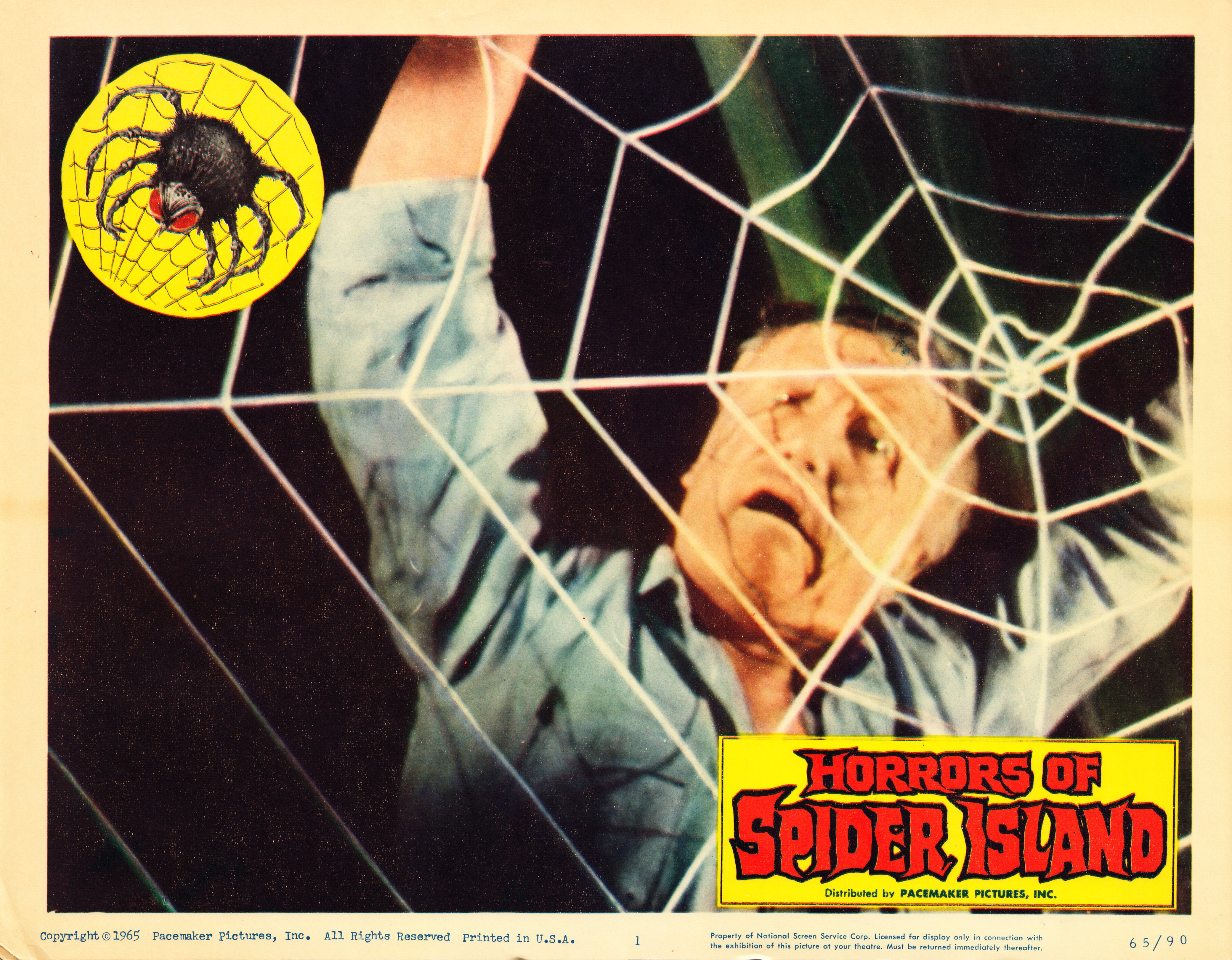
“Remember to not apply any pressure on the web! If possible, don’t even touch it!”

Tarantula – Promotional Photo
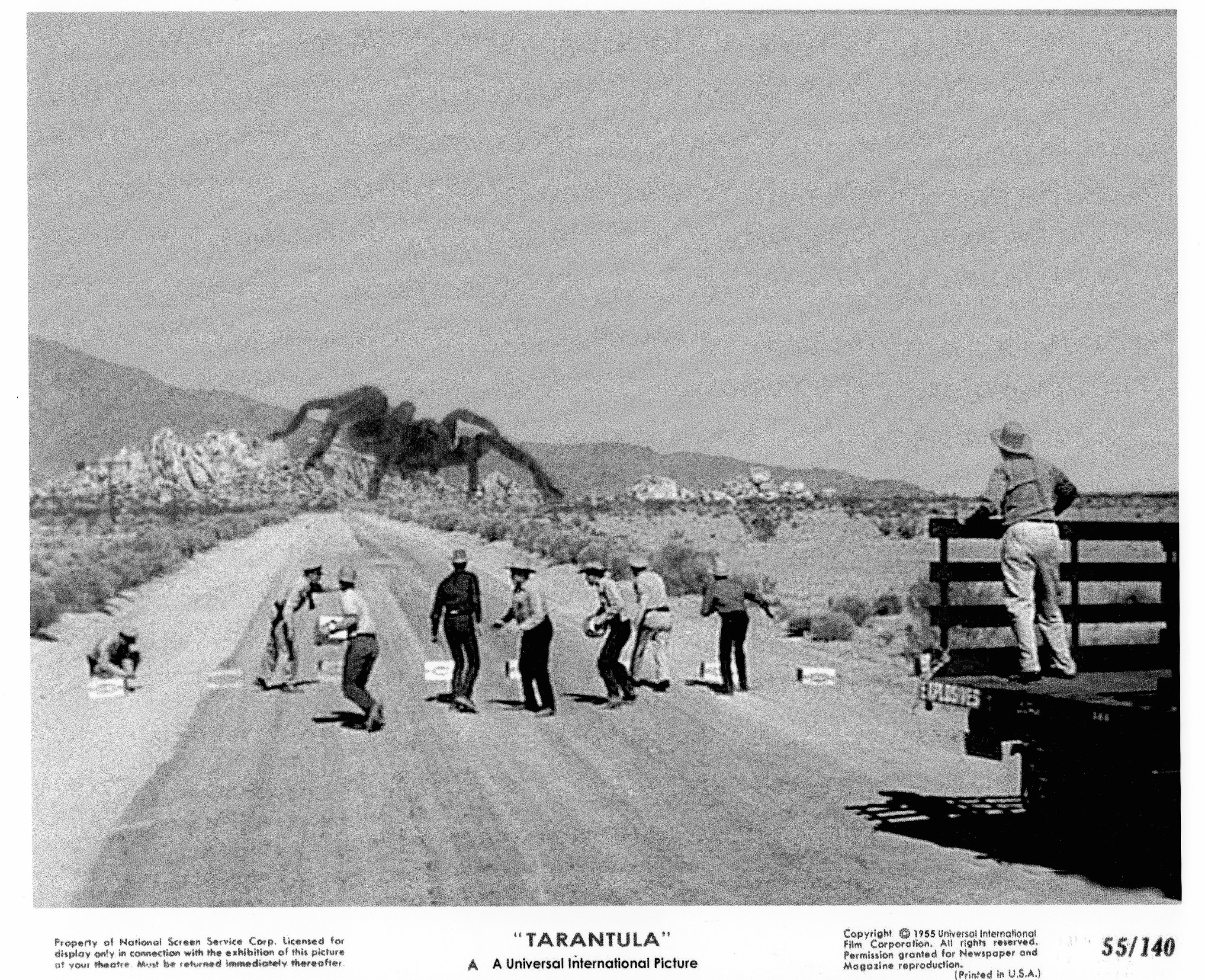
Someone’s going to have to lure the damn thing to the explosives, and it’s not going to be me!
Spiders 3D (2013)
Directed by Tibor Takács
Written by Joseph Farrugia, Tibor Takács, and Dustin Warburton
We start in space, with the title appearing against a starry background.
In space, no one can hear you sigh at the spinning title.
I don’t have a 3D set, but if the title hadn’t mentioned it I wouldn’t have known I was missing something. So, good going titles.
The camera pans until the Earth comes into view. Then we see our planet covered by a spider. As our view pulls back we see that it’s actually on a view port of an orbiting space station. From the dead astronaut and many loose spiders, we may assume that something went wrong. Further, the Cyrillic letters on a clipboard indicate it was a Russian vessel.
If you were thinking that a meteorite would strike the space station, I congratulate you! You’ve seen a movie before.
Meanwhile, in New York City, our hero arrives at a rail transit control hub. Patrick Muldoon (“Starship Troopers”, “Days of Our Lives”) plays Jason, who seems to be some kind of district chief. One of the workers hands him an iPod. This is a gift purchased on Jason’s behalf for some young girl. Like a lot in this film, the details are murky.
When there’s a problem at the Noble Street subway station, transit worker Jimmy goes into the tunnel to investigate. He finds that something has penetrated the tunnel, but his experience fighting in Iraq tells him it wasn’t a bomb. Homeland Security is called anyway. Given that Jimmy fails to notice the large blue spider that crawls out his pants seconds after he’s bitten, it’s probably wise not to trust his observations.
Jason breaks contact with Jimmy to watch a news report on the incident. It identifies the cause as debris from a Soviet satellite launched in the 1980s. Jason decides to see the damage for himself, so he heads out. He tries to reach Jimmy again but gets no response. This is hardly surprising, as Jimmy has passed out from the toxins in his system and landed on the infamous third rail.
Jason pulls up to a subway entrance in a New York Transit van. A body is being loaded into an ambulance, and our hero asks callously if it was a jumper. A woman some kind of uniform who seems to know Jason informs him that it’s Jimmy. She is Rachel, played by Christa Campbell (“Mansquito”, “Day of the Dead”), and we’ll find out more about her later.
Down in the tunnel people in hazmat suits inspect the area with various equipment. They declare it’s free of radiation, and a bunch of officials enter — Jason and Rachel included. A Dr. Darnoff identifies a piece of wreckage as a disposal unit from the satellite. Homeland Security is satisfied, Rachel says the Health Department is not. ‘Waste’ sounds like something potentially hazardous. While everyone bickers over who’s paying for what and when the subway can re-open, nobody notices rats fleeing the area.
Later that night Rachel arrives at a Chinese restaurant where her daughter Emily has been waiting with (presumably) a babysitter, who promptly leaves after being paid. Rachel tells Emily that her father means well, and from their mention of his subway and the presence of gifts we can start to infer that Jason and Rachel might be more than friends.
Jason stops at a hospital, where a Dr. Stella takes him to the morgue. There she confirms that Jimmy died of electrocution. What’s interesting is what hadn’t killed him; she found the spider bite and worse — marble-sized eggs in his abdomen! Jason asks to take them to City Health, which probably violates all manner of procedures, but Stella readily hands them over.
Jason’s next stop is Rachel’s apartment. He gives Emily the iPod, and she happily flees the scene. Jason hands the eggs to Rachel, and she gives him divorce papers. At least we finally understand their relationship.
From here the plot spins into the well-worn patterns of government conspiracy, re-uniting family, and experiments gone wildly out of control. The area around the Noble Street station becomes overrun with spiders the size of people, and it’s up to Jason to stop the enormous queen.
It’s not what you’d call a good movie, but it’s largely entertaining and has some really nice touches. Some of the minor characters actually have significant plot beats, and even the soldiers that enforce the quarantine are shown to be people with their own motivations. The thinnest characterization is Colonel Jenkins, played by veteran actor William Hope (“Aliens”). He’s the villain of the piece, responsible for many of the named-character deaths and difficulties, but the script doesn’t give him any motivation or personality other than the face of pitiless government.
The true joy of this film is the spiders themselves. They’re goofy looking and abundant, growing to the size of a horse in roughly a single day. Then there’s the queen… But first let’s talk origin.
We’re told by Dr. Darnoff that the soviet scientists had tried to splice alien genes into several different animals but that only the attempt with spiders had succeeded. Why would they do this? To produce military-grade silk for making armor. The colonel, of course, wants to drop spider eggs on enemies.
All of which begs several grade-school level questions.
1. Why would you cross anything potentially dangerous with a spider? You know what you cross spiders with? Tomatoes! Tomatoes never killed anybody.1
2. When did the silk plan enter the picture? Did the dead aliens have a gold-plated record that told of the wondrously strong silk their genes produced? It seems more like something the scientists made up when they were caught making alien-hybrid spiders.
3. Why did they stay relatively small in the space station? Granted it’s not like there was a lot of food, but it’s not as though they spent enough time eating to grow as big as they did so quickly on Earth.
4. What did they eat on the space station? A cosmonaut, obviously. But then what? The station was essentially abandoned for decades.
5. After the giant spiders wipe out your enemy, how do you get rid of them? The Orkin army?
Ultimately, it doesn’t matter. All you need to know is that all mysteries are explained by “alien
DNA” and that the queen is the size of a nice house in the suburbs.

One of these two is very smart. The other splices alien DNA into spiders.
While it’s not CGI on the level of “Jurassic Park” or Peter Jackson’s “King Kong”, the effects in this are a darn sight better than the typical fare in modern spider movies. For the most part the spiders interact reasonably well with the environment, and the design is fun. They have big humanoid eyes and multiple sets of jaws. Best of all, the queen shows accumulated damage from all of the bullets and general artillery that have hit it. When so many details are omitted, glossed over, or otherwise left to the viewers’ imagination, this demonstrates that genuine care went into the production.
Overall I found “Spiders” entertaining and a touch above the average monster flick. Despite a run-of-the-mill plot and some standard failings, it’s a movie that I can go back to again and again.
And maybe one day I’ll manage to see it in 3D!
RANDOM THOUGHTS
Patrick Muldoon is no stranger to fighting giant spiders. Even if you don’t count “Starship Troopers”, he starred in the direct to TV “Ice Spiders”.
I actually appreciate that the script leaves Jason and Rachel’s relationship undefined for so long. It seems more natural that they don’t talk about it all the time.
Of all the people in the film, I feel sorriest for the babysitter. It sucks for all the victims, but here’s a girl who was just picking up some spare cash, and she gets put in quarantine and killed almost as an afterthought.
FOOTNOTES
1. “Attack of the Killer Tomatoes” doesn’t count.
Destroy All Monsters – Mini Promo Posters

This gallery contains 2 photos.
Japanese mini promo poster for “Charge of the Monsters”, aka “Destroy All Monsters”. English mini promo poster for “Destroy All Monster”.
1000 Misspent Hours: Mari-Cookie and the Killer Tarantula
There’s a movie that’s been passing around my circle of friends, testing their mettle and their willingness to continue speaking to me. It’s a movie that I discovered because of my fascination with two things: big damn spiders and the nearly contractual obligation for Linnea Quigley to remove her clothing on camera.
The movie is a DTV Jess Franco production, amusingly titled “Mari-Cookie and the Killer Tarantula in Eight Arms to Love You”. It’s the story of a were-spider (Lina Romay) who, well, has a lot of sex. It’s the sort of cinematic effluvium that defies description, but El Santo of 1000 Misspent Hours and Counting came the closet to explaining the experience of watching Mari-Cookie and the Killer Tarantula in Eight Arms to Love You.
I’ll eventually post my own review, someday when I can bring myself to watch it again.
Earth vs The Spider — Mini Lobby Card

Nice gam!
Son of Godzilla — Lobby Card 1 (UK)
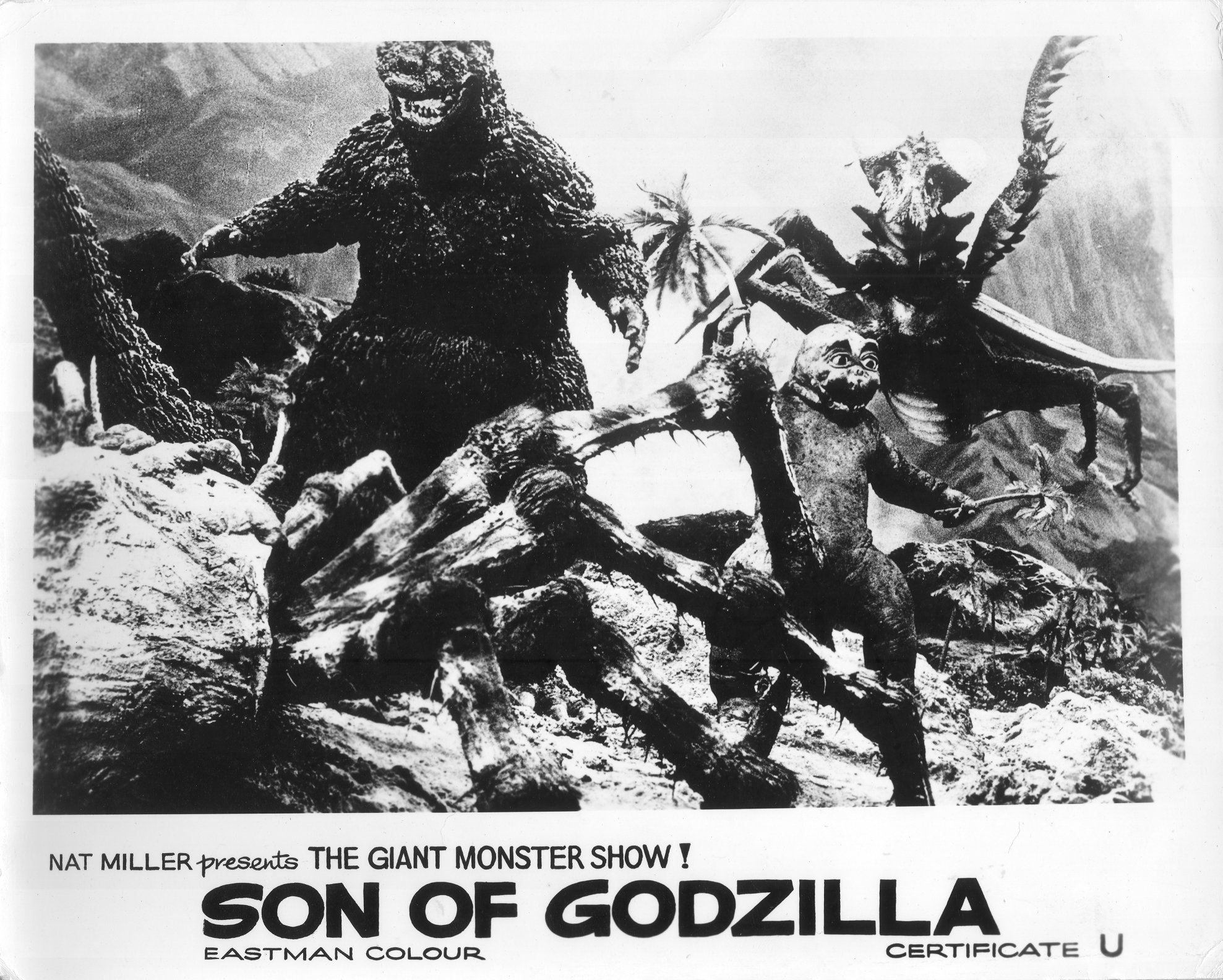
Do we tell Minya that there’s a Kamacuras behind him or just hope he gets eaten?
Earth vs The Spider — June Kenney Promotional Still

June Kenney dangles from the web of the big damn spider!
Checkpoint Telstar: Earth vs The Spider (1958)
The Cold War movie review site Checkpoint Telstar is running a series of horror reviews this month for its HubrisWeen celebration — 26 reviews (A to Z) leading up to Halloween.
Day 5 is a review of the classic Big Damn Spider movie “Earth vs The Spider”, directed by serial BDS user Bert I. Gordon. It’s one of our favorites here in the Web, and Telstar is one of my closest friends, so I hope you’ll give it a read.
“Earth vs The Spider” on Checkpoint Telstar
See ya in the Web!
 Web of the Big Damn Spider
