
Earth vs The Spider — Mini Lobby Card

Nice gam!
Son of Godzilla — Lobby Card 1 (UK)
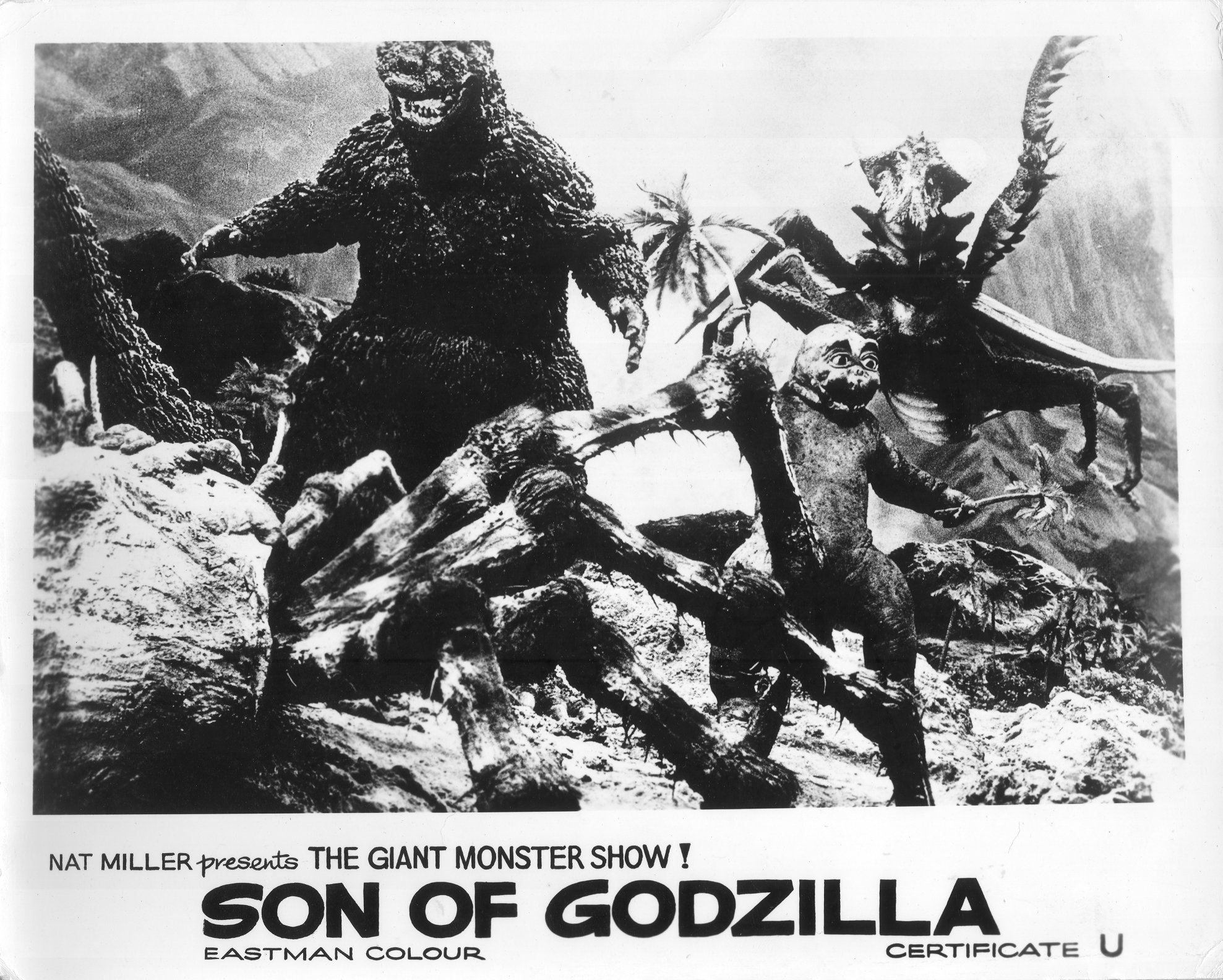
Do we tell Minya that there’s a Kamacuras behind him or just hope he gets eaten?
Earth vs The Spider — June Kenney Promotional Still

June Kenney dangles from the web of the big damn spider!
Mesa of the Lost Women – Promo 1

Tandra Quinn in a promotional image for “Mesa of Lost Woman” with the movie’s spider.
Checkpoint Telstar: Earth vs The Spider (1958)
The Cold War movie review site Checkpoint Telstar is running a series of horror reviews this month for its HubrisWeen celebration — 26 reviews (A to Z) leading up to Halloween.
Day 5 is a review of the classic Big Damn Spider movie “Earth vs The Spider”, directed by serial BDS user Bert I. Gordon. It’s one of our favorites here in the Web, and Telstar is one of my closest friends, so I hope you’ll give it a read.
“Earth vs The Spider” on Checkpoint Telstar
See ya in the Web!
The Black Scorpion (1957)
Written by David Duncan and Robert Blees
Directed by Edward Ludwig
Giant critters were a staple of the drive-in fare of the late 1950s. “Tarantula”, “Them!”, “The Beginning of the End”, and so many others — the genre consisted largely of forced perspective filming, footage of animals super-imposed over actors, and the occasional puppet. In these standard techniques “The Black Scorpion” falls squarely on its drooling face. Where it excels is in the superb use of stop motion animation for the majority of its creature effects.
The film opens on stock clips of volcanos and earthquakes as a narrator ponderously explains the setup. He tells us that before forces that are “the most violent of modern times”, the people of Mexico can only pray. (Cue prayer footage.) A new volcano is formed, he tells us, and it grows 9000 feet in only a few days!
No one will be seated during the rather bland opening credits.
When the opening credits end, we see a jeep hauling a small trailer through the wasted landscape. The vehicle stops, and our male leads climb out to drop some exposition. Hank Scott is an American, visiting Mexico through the courtesy of Professor Artur Ramos. They are geologists who’ve driven through the destruction for three days to reach the new volcano. Amid all the waste lies a literal sign of life: a road marker which (if somehow still close to its standing position) indicates that they are 117K from Mexico City1 and only 12K from San Lorenzo. There are also indications that at least one other vehicle has been through here recently.
Continuing their journey, Ramos and Scott come upon workers repairing phone lines. These men affirm that San Lorenzo is near but haven’t heard how the town has fared in the wake of the disaster. The bridges might be out, they warn. A police car that headed that way never came back, though, so it’s possible that the route is clear2. The geologists thank them and continue their thrill-a-minute drive.
They locate the police car in a tiny deserted village. The car, and pretty much everything nearby, has been demolished. They can’t tell by what, but it may be related to that buzzing sound… Scott and Ramos find one survivor (a baby) and one victim (the police officer). They use the police radio to call in their discoveries then continue on to San Lorenzo, where military assistance should arrive the following day.
A crowd greets them in San Lorenzo, and after handing the baby to a nearby woman our heroes join Father Delgado for some dinner and expository dialog. It seems that in the aftermath of the eruption there have been other disappearances and unusual destruction. When victims have been found, their bodies are bloodless and their faces frozen in fear. Largely fueled by rumors from local caballeros, the masses believe it to be the work of a demon bull3.
Of course, none of this dissuades our intrepid duo from heading ever closer into danger. The following day, against the advice of Major Corsio (head of the newly arrived army unit), our action geologists continue driving toward the new volcano. They meet up with Teresa Alvarez, owner of the Alvarez ranch (whose cattle herders have fled, fearing the demon bull). Ramos discovers a sheet of unearthed shale, and after a lot more exposition and a meal the plot finally lurches begins in lugubrious earnest.
If you think I didn’t care for this movie, you’re partially correct. The pacing is atrocious, the plot meandering, and the direction tepid. I’ve seen far worse, but on a scale of “Unwatchable” to “Play It Again Now!” I would give it an honest “Well I’ve Seen That Now”… except. Ah, except for the wonderful, animated scenes of giant scorpions and other critters!
The great Willis H. O’Brien (“King Kong”, 1933) designed and supervised the effects, and his protegé Peter Peterson handled the actual animation. There are a few major set pieces, and they are a joy to behold: the lost underground world, the train tracks, and the stadium. The scenes at the train and stadium feature a lot of giant scorpion on vehicle violence and even the grisly demise of a few animated people. They’re a fun treat for fans of stop motion animation.
The reason I’m writing about this movie is what happens deep underground. Amid all the seismic activity of the eruption, an entrance opened on a world that had been sealed underground since pre-history — an enormous set of caverns in which monsters live brutal lives. It’s down here that Juanito meets a trap-door spider roughly the size of a brown bear.4

Wait. Six legs? We found the spider that everyone in “Camel Spiders” kept talking about!
“Wait”, you cry. “Who’s Juanito?”
Remember Teresa Alvarez, whose caballeros believed in a demon bull? Juanito is a servant boy on her ranch, and it is truly unfortunate that he stuck around. Whenever he’s told to stay put, he immediately sneaks off to run straight toward the scorpions. It’s amazing to me that nobody ever thought to tie Juanito down.
Naturally, when Ramos and Scott decide to descend into the crater via a lowered cage, Juanito tags along. This, immediately after being discovered hiding in the jeep, whereupon he had once again been told to stay the hell put. Somehow, two scientists fail to detect the child during a twenty-minute descent in a cage the size of a closet. Once they reach the bottom, the men tramp off, leaving Juanito to find some danger — which he does with a quickness!
Juanito leaves the safety of the cage and wanders directly to the lair of a big damn spider. This kid is so determined to die that he actually tugs at the spider’s trap door! Naturally, Ramos and Scott must rush over to save him. Mercifully the action soon moves to Mexico City, and the plot is no longer propelled by Juanito’s self-destructive urges.
This spider is an odd one. For one thing, it only has six legs. That’s assuming that the front appendages with pincers are pedipalps, which they would be on a scorpion. Additionally it doesn’t exactly leap out of its tunnel, which sadly allows Juanito plenty of time to get running. If we’re to assume any attempt at historical accuracy it could be that this arachnid is from a lost family of the sub-order Mesothelae, but it seems unlikely that much thought went into it.
With limited time and budget O’Brien and Peterson put the main effort into the scorpion models, which are excellent. The spider and another creature (a sort of worm with arms) are left over from O’Brien’s work on King Kong! They were two of the monsters at the bottom of a ravine, in one of the most famous cut scenes in the history of cinema. It’s neat that they were pressed into service again a quarter of a century later, but their design esthetic does not sit well alongside the more modern work.
Budget is the enemy of many films, but its lack is painfully visible here. The super-imposing process of the 1950s was labor intensive, and there was just too much to do. The result is a number of scenes that show the silhouette of a scorpion over running crowds. This is the matte over which the animation was to be placed, and it doesn’t look good on its own.
The other thing that looks bad is the scorpion head used for close-up shots. O’Brien supposedly supervised all of the effects, but he must have been looking elsewhere when this puppet was made. All of the realism and artistry of the animation models is completely absent here. It has a goofy, gaping maw that’s constantly drooling and googly eyes, and it looks nothing like the creatures taking apart trains and pulling helicopters out of the sky.
Hampered by a meandering script and budgetary constraints, “The Black Scorpion” nonetheless marks a high-point in arachnid cinematic effects. Far superior to most puppets and better than low-budget CGI, it’s a shame they weren’t part of a worthier movie.
FOOTNOTES
1. It is actually far from ludicrous to imagine a volcano appearing so near Mexico City. The city lies in the path of the Trans-Mexican Volcanic Belt, which forms a roughly latitudinal line across the country. There is even an active volcano only 40-some miles away. I will not speculate as to the odds of the spontaneous generation of such a massive new volcano in the region, but I think that the side effects of such an event would be catastrophic enough without adding giant prehistoric scorpions into the equation.
2. Whenever a character thinks that someone never returning is a good sign, I can only marvel at their innocence. If I go two hours without hearing from someone, I assume they’ve been eaten by dingoes.
3. Sadly, the legend of the demon bull is largely glossed over. It seemed far more plausible than the actual danger presented.
4. Nope. I’m not invoking the scorpions-are-arachnids clause to justify including this movie in the Big Damn Spider canon, although scorpions are way closer to spiders than whatever the heck this creature is. It only has 6 legs, so maybe it’s an escapee from “Camel Spiders”.
Krull Mini Lobby Cards (1-8)

This gallery contains 8 photos.
The complete set of US mini lobby cards for “Krull”. I have no idea why they didn’t show off the magnificent spider!
Godzilla’s Son Kumonga and Kamacuras Toys

Very wee giant monsters.
Camel Spiders (2011)
Written by J. Brad Wilke and Jim Wynorski
Directed by Jim Wynorski
Early into the US occupation of Afghanistan, a photo of soldiers was widely circulated in which a pair of camel spiders hung grotesquely in the foreground. For a week or two everyone shuddered at the thought of those humongous Middle-Eastern spiders, and then we collectively forgot about the whole thing. Inevitably, Roger Corman produced the movie “Camel Spiders”. The only real surprise was that it took almost a decade for him to get around to it.

That green is nature’s way of warning viewers to avoid the film.
The film opens during a firefight in Afghanistan. American troops are pinned down by rebels (extras in street clothes, some of whom are literally wearing towels), who are likely meant to be Taliban forces. In a way, it doesn’t matter. Partly this is because they’re all about to die horribly, but mostly it’s because they are irrelevant to the plot.
What is relevant to — and indeed is — the plot, is how these Afghanis die. Pale spiders, about the size of cats, crawl over the combatants and fang them to death. They then drag away two of the bodies before the American troops eventually notice the lack of returned fire and investigate.
The medic determines that it was death by beshbesh — camel spider. These are deadly desert spiders that can outrun men and inject a powerful venom with their bite1. Captain Sturges (Brian Krouse, of “Sleepwalkers” and the TV series “Charmed”) is more concerned about his own side’s single casualty.
Corporal Plot-Device has been killed in the bullet exchange, and the lightly wounded captain assumes responsibility for taking his body home. Despite ample photographic evidence of the stately manner in which the bodies of our soldiers are transported, the corporal is crated up with a few rodent-sized camel spiders and shipped to a military base in Arizona, where it’s put on a truck transporting munitions.
The driver of the truck is Sergeant Underwood (Melissa Brasselle2), and the clumsy sexual tension between her and Captain Sturges will be an uncomfortable feature of the rest of the film. Fortunately, it’s broken for the time being by an accident.
The local sheriff (C. Thomas Howell) is in hot pursuit of some guy. I didn’t write his name down because, like so many characters in this movie, his only purpose is to cause trouble through his demise. Seconds after his introduction, this presumably naughty person runs into the sergeant’s truck.
Three things happen:
- Our speeding driver either dies or is carted off to a hospital. His impact on the plot done, he is quickly discarded.
- The truck is damaged, which ensures that the captain and sergeant have to stick around.
- The corporal’s coffin falls out of the truck, introducing camel spiders into the Arizona wilds3.
The truck can still move a bit, so the sheriff guides our nascent couple to a motel. Captain Sturges calls the base and arranges for a pick-up the next morning. Then he and the sheriff head to a diner, leaving the sergeant to guard the semi-broken vehicle with its corpse and munitions.
The diner is filled with characters, and from the attention given them it is clear that they are to become the primary group of survivors and victims for the remainder of the film. There’s the bickering couple with a distanced teenager; the owners of the diner; a pair of investors, who want to tear town the diner and build a casino; the waitress a heart of gold; and two guys so into their own jaded skepticism I can only assume their journey to Las Vegas is ironic. There’s also the minority chef, whose death signals the arrival of the camel spiders.

Santa Moose and his eight camel spiders come for the naughty children.
From this point the movie centers on survival, as the group attempts first to escape then to wait out and finally to destroy the 8-legged, Afghani invaders. Families come together, jerks get a clue, villains get theirs, and the innuendo-fueled romance of Sargeant Underwood and Captain
Sturges inexplicably blossoms.
There are two other groups of people who appear early in the film. Their paths never intersect that of the main characters. In fact, this isolation is so complete I suspect that at least one of these sections was added after principal shooting stopped. Given that the movie only clocks in at 79 minutes, I’m almost certain of it.
It would be wrong to call “Camel Spiders” cheap; it’s budget-conscious. Over decades of working for Corman, Wynorski has learned how to spend effectively. The sound and image are clear, because it pays to spend on recording. It doesn’t pay off as much to costume extras that only have a few minutes of screen time. He skimped on the Afghani rebels, and I honestly didn’t even notice that the first time I saw it. Characters are left as broad, archetypal strokes. Any investment in them comes from our associations with the familiar roles. A remark now and then reminds us where they all are on their usual path to redemption or spider chow.
Likewise, the CGI effects are mediocre at best. The spiders aren’t convincing, and they often fail to interact with the environment. Blood sprayed frequently but unrealistically. You’d think that here is where the money should be spent, to make the central menace believable. I’d think so too, really. I’m inclined to believe that Jim Wynorski agreed. It’s likely that with the volume of effects this was as good as could be provided by the budget. Given the choice of quantity over quality, well… this is a Roger Corman production.
The large number of spiders is a pretty good trade for quality. The demands on the actors and script are significantly reduced by the frequency of spider appearances. There’s some screaming, a lot of running, then a pause to drop some clumsy character beats — that’s the basic pulse of the movie. The rhythm never becomes frantic, but it’s active and never let’s the movie lose you entirely. In fact, it’s a lot of fun without being any good at all.
A case in point is what I call Chekov’s spider4, a spider shown in the first act that comes into play before the end of the movie. This is as close as the movie comes to a real payoff for paying attention. Shortly after the coffin falls out of the truck, a camel spider crawls into a car through its open sun roof. Almost immediately, someone takes the car to go get help but arrives safely. The spider, apparently, is napping. Much later on, long after the audience has given up on that particular plot point, someone else sticks his head in the car window and gets a face-full of spider. The delay is almost clever, and as such it sticks out in a movie that asks so very little of its audience.
Give “Camel Spiders” a minimal amount of your attention, and in return it will give you all it’s got. As little as it has, that’s a pretty even trade.
RANDOM THOUGHTS
In fact, camel spiders are not “true spiders”. They’re related arachnids belonging to the order Solifugae. The movie alludes to this with the constant refrain of “It’s only got six legs!” In fact, camel spiders have eight legs.
Two camel spiders hitch a ride with the corporal’s body. However many there were by the time of the car accident (whereupon every last one fled for the desert), they all had to fit in the coffin. A few hours later, there were dozens of them at the diner. By the following morning, hundreds swarmed the abandoned facility, and some were the size of a person! These are breeding and growth rates that don’t just defy reason — they walk up to reason, break its cane, take its wallet, and give it a good kick before running away laughing down the street.
Why do the experts always walk right up to get bitten? Don’t they cover that in the introductory classes?
There’s a locked door in the gypsum plant. We never find out what’s behind it, and it’s sort of driving me nuts.
FOOTNOTES
1. Camel spiders are non-venomous, grow to about 6″ max, and top out at about 10 mph.
2. Melissa Brasselle is not only a Corman regular but has worked almost exclusively with Jim Wynorski. Out of a few dozen appearances, no fewer than 17 have been in his films.
3. While this particularly fictional breed of camel spider is indigenous only to the Bronson Canyon region of Afghanistan, real camel spiders are present throughout the world in sandy environments.
4. Yeah. I referenced Anton Chekov in the review of a crap spider movie.
 Web of the Big Damn Spider
