
Dragonquest (2009)
Writers: Brian Brinkman and Micho Rutare
Director: Mark Atkins
When you find yourself watching an Asylum film, you have two options: set the bar low, or go wash the dishes. There was something fermenting under all the tableware in the sink, so I chose to keep watching “Dragonquest”. Besides, I’d been assured that the fantasy adventure contained a big damn spider for no damn reason.
As it turns out, there’s no reason for most of what happens in “Dragonquest”, but I’ll get to that later. First, there was a rocky outcropping…

Technically, it’s more of a Dragon Field Trip.
The movie opens with some long aerial shots of terrain, then settles on a ledge high on a barren cliff. Here, a hooded figure (Brian Thompson, recognizable to any fan of “The X-Files” as the alien bounty hunter) squeezes a large gem until blood pours out. His name is Kirill, and his ritual summons a crap CGI dragon made of crap CGI shadows.
From this ominous beginning, the story shifts to an idyllic rustic village, where an idyllic young peeping tom uses a spyglass to see what an idyllic young maiden has under her blouse. Sadly, this sexual-predator in the rough is our hero.
His name is Arkadi, and he lives with Grandfather, the kind of wise old man who always winds up watching over orphaned protagonists in hiding. He is not amused by Arkadi’s antics — chasing girls and smoking what appears to be fairy dust. The little pervert probably keeps Tinkerbell locked in a chest with his dirty scrolls.
Sensing the coming of plot, Grandfather gives Arkadi an amulet. It’s very shiny for an artifact that has been hidden away, and it’s shaped like a cross between a knot and a honeycomb. Our hero is sent several inches away so that Grandfather may confer not at all secretly with another villager.
It seems that Arkadi is destined to succeed where Grandfather has failed. We’re left to imagine that this most be something important, but not for long. The shadow dragon arrives and starts burning everything in sight. Grandfather, of course, dies sending the dragon away. He did manage to send his friend to warn the King.
As for Arkadi, he is sent to find Maxim (about whom he knows nothing). The fate of the partially disrobed village girl is not known.
Grandfather’s pal goes to the King’s castle and tells everyone he meets about Arkadi before admonishing them against telling anyone else. One of the King’s men promptly hies himself to Kirill to spill everything.
There follows an epic battle between the forces of good and evil, represented by about five dudes taking turns falling down. Arkadi stumbles on this scene, and he talks briefly with the King before his majesty gets flambéd by Kirill’s dragon.
In what becomes a recurring theme, Arkadi stumbles blindly away from the action.
It is telling that some of the only dark-skinned actors in the movie are the bandits who jump Arkadi as he wanders toward his destiny1. It is also telling that the only reason for this attack is to introduce Katya, a warrior trained in the arts of applying make-up and fighting in corsets. She rescues Arkadi and leads him to Maxim — portrayed by Marc Singer as a growling land-pirate — who finally puts the plot train back on the rails.
It seems that Maxim, Kirill, and Grandfather were all part of an organization called the Brotherhood. Their purpose is unclear, but it somehow involves continually hiding a bunch of gems that represent virtues and getting people to collect them again. Grandfather got all of them but one — humility — and apparently after some time limit was exceeded the gems were taken away from him and re-hidden. I’m speculating here, but no reason is ever given for why they all have to be found again.
The amulet that was given to Arkadi is for turning the gems into one amazingly gaudy bauble. For some unclear reason, Grandfather believed that Arkadi was possessed of the necessary virtues to collect them all — meaning that there must be gems for lechery, laziness, and generally being a doofus. It’s hard to know for sure, as after an initial, rapid rundown most of the virtues are never again mentioned. Regardless, Arkadi is now the Keeper, and it’s his job to prevent the quaffle from passing through his goal hoops. Or to prove himself virtuous enough to create his own crap dragon, whichever.
From here, the story settles into the titular quest, and we see Arkadi blunder from one pointless challenge to another as he wanders toward his inevitable, unearned victory.
Typical of these challenges to his virtue is what I call the Challenge of Pretending There’s a Big Damn Spider. Arkadi has been sent off on his own while Maxim and Katya go somewhere else (hopefully to call their agents). Seeing a cave, our hero decides to poke around in it. He finds himself in an improbably well-lit tunnel, where he stands as a giant spider saunters past him. Then he looks down and sees a gem.
There may as well not have been a spider at all. Or a cave, really.

Arkadi demonstrates the virtue of Invisibility to Arachnids.
Every now and then you can see some slim connection to a virtue (chastity, represented by not immediately rubbing parts with a stranger), but none of it is particularly challenging or proves much of anything unusual in his character. That’s the really frustrating thing about the movie; Arkadi’s rewards feel like prizes for participation, not a proof of his superior inner qualities.
Asylum has a reputation for churning out low-budget genre films with generic plots and slumming B-list actors. The surprising thing about “Dragonquest” is that the familiar fantasy elements are thrown together into a completely incoherent mess. Nothing fits together except for the constant refrain of collecting the Stones of Virtue, which activity is so random and non-challenging as to suggest divine intervention.
That could explain why the spider’s legs disappear at certain points in its ambling. Or maybe it’s just that nobody really cared enough to put forth any kind of effort for an Asylum feature.
RANDOM THOUGHTS
- It was awfully nice of Kirill to wait until Arkadi got the amulet before launching his attack.
- I honestly couldn’t tell if the King put himself out of his misery or stabbed at the dragon as he burned to death.
- I need to watch a good movie soon.
- Unsurprisingly, this is the first screen-writing credit for both of the writers, Brian Brinkman and Micho Rutare.
FOOTNOTES
1. If the only black actors in your modern movie are bandits, you should probably take a sensitivity course. I mean, yay for breaking up the blinding glare of paleness, but would it kill you to spread people around?
Have Rocket — Will Travel (1959)
Written by Raphael Hayes
Directed by David Lowell Rich
Writing a review of The Three Stooges is an interesting challenge. Narrative coherence is irrelevant when the story only exists to provide an excuse for eye-gouging and set-wrecking. Dialogue doesn’t need to be more eloquent than an angry “Why you!” I’m not even certain that normal standards of acting apply. But, since there’s a giant spider in their film “Have Rocket — Will Travel”, I’m prepared to work through all that.
Let’s start with the title. If it doesn’t sound familiar, it should. Stooge titles tend to be plays on expressions or titles of other works. In this case, it’s a reference to the popular western show “Have Gun — Will Travel” that began airing in 1957 — two years before the release of this film. There’s no other connection to the show, but the reference is reinforced with a title song that is sung by the Stooges over the opening credits.
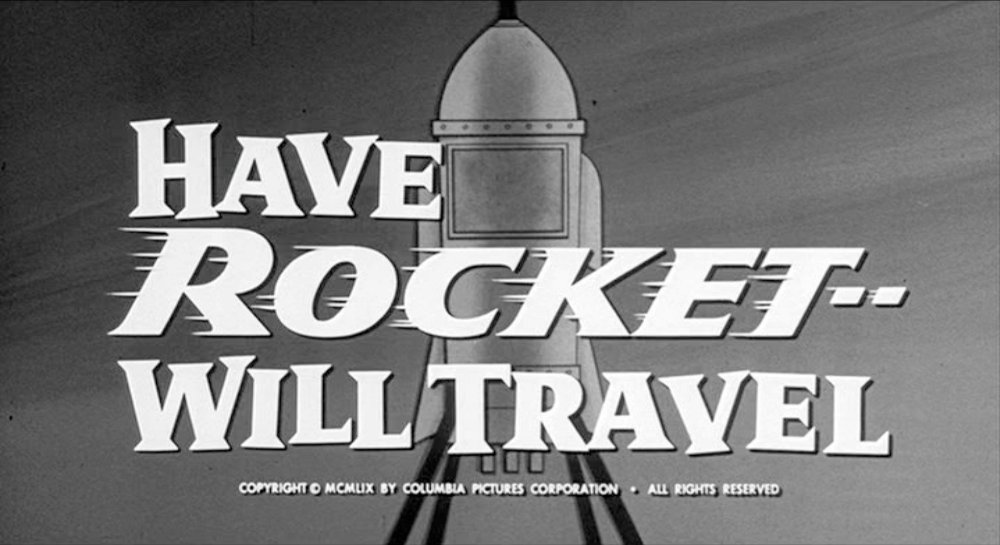
I’ll watch your movie. Just please stop singing.
Speaking of credits, the Stooge line-up for this outing is Moe Howard, Larry Fine, and Joe DeRita (Curly-Joe). Curly-Joe gets some guff for being the second substitute Curly, who himself replaced Shemp. (Being the third Stooge was seemingly as fatal as drumming for Spinal Tap1.) Curly-Joe does a decent enough reproduction of Curly’s routines, and he provides some genuinely entertaining moments, so I’m not going to dump on the guy. I think he just suffered from being cast at a time when the Stooges were just re-enacting stale clones of their previous routines.
Speaking of clones, I should give a quick rundown of how the set pieces stitch together.
We start with a rocket test by the National Space Foundation (NSF). This is their 4th launch, and there’s a monkey on board — because I guess in the 1950s it was mandatory to put a monkey in space movies. The test fails, and the rocket crashes. The Stooges, who are the maintenance men on the base, are put in charge of guarding the fallen rocket. This leads to the Stooges chasing the monkey all over the rocket until it accidentally rights itself.
Here’s where things get unnecessarily complicated. Dr. Ingrid Naarveg, lead (and apparently only) scientist at the NSF, is nice to the Stooges. They see her as a daughter and want to help her keep the project alive. In order to do that she needs to find a better fuel. Stooges to the rescue! In the course of a night they brew up a more powerful fuel (the secret is sugar!) and load it into the rocket.
The head of the NSF, angered by the Stooge’s nocturnal activities (and the inevitable ancillary destruction), manages to chase them into the rocket and launch it into space. Our promised space travel is under way at last!
Once on Venus, the Stooges encounter a talking unicorn, a giant spider, and a tyrannical robot (that makes clones of them because it likes their form). They also sing more of the title song. On their return, the Stooges are hailed as heroes. They leave the clones in their place and run off with the talking unicorn to sing more of that infernal song.
You don’t have to be a Stooge fan to find their rise to fame predictable. It’s a given in American comedy that experts are fools and fools are experts. Opposites attract, experts are unmasked, the simple are rewarded, and there’s probably a wedding.
In this case, the wedding is between Dr. Naarveg and the base psychiatrist. Barely in the movie, their roles consisted primarily of 1) Dr. Naarveg providing unnecessary motivation to the Stooges and 2) the psychiatrist repeatedly telling her that she’ll only find happiness by marrying him and abandoning her career. He finally convinces her with a sudden agarring2. It was, after all, 1959, and while a comedy could make a woman the lead scientist in a space program it would also make certain to put her back in her place by the end.
Additionally, while the pompous head of the NSF gets a humiliating take-down, remember that three bumbling clods managed in one night to produce the breakthrough in fuel that eluded Dr. Naarveg. That’s got to hurt.
Some of the Stooge routines were painful, too. Interestingly, it wasn’t due to the performances. A classic routine is a classic routine, and old and fat as they are the Stooges are skilled physical comedians. I place the blame on the director, David Lowell Rich. Rich was a workman director, the bulk of whose career was spent in TV. B-Movie fans may have seen the TV movie “Satan’s School for Girls” (an Aaron Spelling production), but his most remembered work is possibly “The Concorde — Airport ’79”, the final nail in the coffin for the Airport franchise.
It’s clear that Rich and cinematographer Ray Cory had no idea how to film the Stooges. These are guys who mastered their craft on the stage, and when they went to film they largely kept that full view ethos. They fill the screen with broad movements and large messes. Here, the camera often slows things down, breaking the frenzy of action into careful and discrete pieces. It just doesn’t work well, and (as in “Yellowbeard” and “The Villain”) the humor doesn’t survive filming.
That isn’t to say that nothing works. A few scenes work very well, mostly because the close shots are mixed well with larger fields of chaos. Two of these are standard Stooge set pieces: the bedroom and the ballroom. The first shows the unusual morning routine of the Stooges, and everyone wrestles with appliances, clothing, and furniture. The second, of course, winds up in a pie fight.
The society ball is where Curly-Joe shines. While the others are dancing enthusiastically with their new admirers, Curly-Joe just wants a piece of cake. His doomed effort sends the soirée flying face-first into its pie-filled fate, while he calmly accepts what is left for him. It’s a sequence that’s both entertaining and oddly reassuring.
The other fun scene was the invention of the rocket fuel. Dr. Naarveg’s lab becomes a kitchen as the Stooges start mixing ingredients in a large vat. Much of the ensuing business is familiar, but it’s less pat than the other scenes. There’s something delightful about Larry intently brewing coffee over a bunsen burner, like the Walter White of caffeinated beverages. Of course, not even Larry tried to cook with the flame-throwing giant spider.
That’s right: flame-throwing giant spider.

Pretty much my worst nightmare.
Almost immediately after disembarking on Venus, the Stooges are threatened by a giant tarantula (courtesy of forced perspective shots and editing). Then the film stops, and a light beam is drawn in, emanating from the tarantula. Flame pursues the Stooges as they run away.
I’d like to tell you that there’s no real reason for there to be a flame-throwing giant spider on Venus. The crazy part is that there is a terribly convoluted reason.
You see, despite all the nonsense about making fuel, the rocket is launched by igniting a lengthy fuse. It’s a strange plot point, requiring the base commander to accidentally (and angrily) light the fuse to send the Stooges on their voyage. Mysteriously, there is some fuse left for the return trip, and it’s up to the flame-throwing giant spider to reignite it.
I fault screenwriter Raphael Hayes for the clumsy movement of the script, but I have to admire his fierce devotion to the fuse gag — a device that backed him so far into a narrative corner that only a flame-throwing giant spider could get him out of it.
RANDOM THOUGHTS
- While rocketing to Venus, the Stooges turn on the communication console and get a TV Western. They change the channel and tune in the NSF lab, where Dr. Naarveg and her suitor are engaged in a dramatic scene in the style of a soap opera. I really liked the thought of the console having been installed so the monkey could watch his favorite shows.
- The robot is delightfully ill-constructed. It looks like the prop guy just stuck a bunch of crap on a box until he ran out.
- The Stooge snore gag works every time.
- There’s a keyhole at the base of the rocket. I find that charming, for some reason.
FOOTNOTES
1. To be fair, Joe Besser didn’t die “in office”, as it were.
2. agar, v.t. to kiss the bejeesus out of a co-star. Named for John Agar, the grand master of the technique.
 Web of the Big Damn Spider
