
L’araignée d’or (1908)
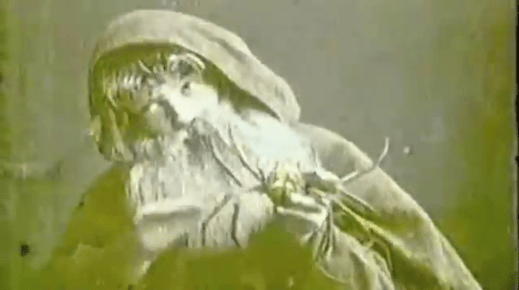
aka The Gold Spider
Written and Directed by Segundo de Chomón

This one is a special treat. Not only is it the earliest big spider movie I’ve heard of, but it’s also one of the oldest surviving representations of a spider on film! It’s only eight minutes long, and one shot is badly damaged, but L’araignée d’or is a splendid example of early narrative film and special effects.
Big Ass Spider! (2013)

Directed by Mike Mendez
Written by Gregory Gieras
Starring Greg Grunberg, Lin Shaye, Ruben Pla, Alexis Kendra, Lombardo Boyar, and Ray Wise

Titles are important. They set audience expectations of tone and content. Other factors play into it of course — trailers, posters, tie-in products — but in the end, it’s just the title listed with a time. So when I learned there was a film named Big Ass Spider! I figured it would deliver a big damn spider, a comical tone, and hopefully enough action to make up for its shortcomings. Spoiler: my guess was right.
Valley Of The Dragons (1961)

aka Prehistoric Valley
Directed by Edward Bernds
Written by Edward Bernds and Donald Zimbalist
Based on the novel Career of a Comet by Jules Verne
Starring Cesare Danova, Sean McClory, Joan Staley, and Danielle De Metz
Jules Verne is perhaps best remembered today for the novel Twenty Thousand Leagues Under the Sea. The story of Nemo and his advanced submarine has been adapted to screen many times, as have his works Journey to the Center of the Earth and Around the World in Eighty Days. So popular were movies of Verne’s adventure stories that it was tempting to produce anything that his name could be attached to. For instance, by using just the barest premise of Of On a Comet (here credited as the subtitle of the translation called Hector Servadac; or The Career of a Comet) the producers of Valley of the Dragons were able to promote a rambling Lost World ripoff as being a Jules Verne movie.
King Solomon’s Mines (1985)
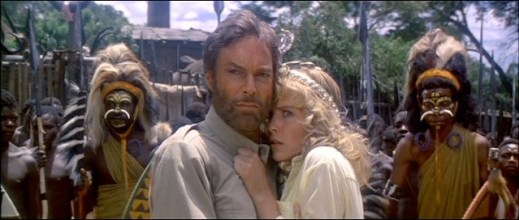
Directed by J. Lee Thompson
Written by Gene Quintano and James R. Silke based on the novel by H. Rider Haggard
Starring Richard Chamberlain, Sharon Stone, Herbert Lom, John Rhys-Davies, Ken Gampu, and June Buthelezi
Raiders of the Lost Ark made a huge splash when it came out in 1981, immediately creating a wave of adventure movies. The success of Romancing the Stone in 1984 proved that the treasure-hunting genre still had plenty of steam in it, although imitators of both films fell rapidly into the forgotten crevices of empty theaters. It was inevitable that Cannon Films would try to catch the train and hubris that they’d do so with a 2-picture deal for the dusty adventures of Allan Quatermain, the Great White Hunter.
Ator, the Fighting Eagle (1982)
aka Ator l’invincibile
Directed by Joe D’Amato
Written by Joe D’Amato and Michele Soavi
Starring Miles O’Keeffe, Sabrina Siani, and Ritza Brown
Flames… Burning… On the side of my title credits!
The sword and sandal genre once thrived, with heroes like Hercules and Samson knocking down pillars and wrestling lions. Maybe it died off because other cheap fare was more marketable, or perhaps an audience that had rejected tight shorts on men now demanded their heroes wear pants. Whatever the cause, it wasn’t until Arnold Schwarzenegger donned the loincloth for Conan the Barbarian that buff men running around in their underwear muscled their way back into theaters.
The Devil Rides Out (1968)
Directed by Terence Fisher
Written by Richard Matheson, from a novel by Dennis Wheatley
Hammer Films dominated horror in the 1960s, with their stylish Gothic approach and stable of charismatic actors. Their Dracula and Frankenstein franchises were particularly lucrative, and while it would be stretching things to say that they could do no wrong during this period, it’s reasonable to expect a certain high degree of quality. The stakes get raised when considering the creative team behind The Devil Rides Out.

The opening titles are a wash of swirling smoke and green symbols of the occult.
Terence Fisher had directed several of Hammer’s hits, including The Curse of Frankenstein, Horror of Dracula and The Hound of the Baskervilles. Richard Matheson had helped turn his own book I Am Legend into the famed movie The Last Man on Earth, starring Vincent Price. He’d written the screenplays for Roger Corman’s Poe adaptations The Raven, The Pit and the Pendulum, and Tales of Terror. Between them, Fisher and Matheson brought an impressive resume to the table.
Then there’s Dennis Wheatley, an English author whose writing influenced Ian Fleming. His first published novel, The Forbidden Territory (1933) featured the Duke de Richleau. The following year saw the release of both a movie version and the second in what would be an 11 book series of the Duke’s occult adventures, The Devil Rides Out. Still a best-selling author in the 1960s, it could be assumed that Wheatley’s works would have been familiar to British audiences for this adaptation.

“Please, this time — just listen to what I’m telling you!”
It’s clear that Matheson relied on this familiarity. Characters have relationships that are glossed over, as though unnecessary to explain. The Duke just happens to know everything about the occult, and his knowledge is explained with a terse comment about his studies. It feels like several scenes are missing, and in fact there are — an entire book’s worth! The result is a mixed bag. On the one hand, it’s kind of realistic that we don’t get a lot of context. People are busy fighting Satan and don’t have the time to re-establish their relationships. Yet it distances the viewer a bit as well. There’s a tight central group of characters, and we’re on the outside. It’s frankly a little off-putting.

The Eatons, with young Peggy hanging on Uncle Rex. They also call de Richleau uncle, so who knows if they’re even actually related to anybody?
Fortunately, the film stars Christopher Lee in the crucial role, here very slightly renamed as Duc de Richleau. Lee’s authoritative manner makes de Richleau seem more than capable of besting Lucifer at anything from magic to snooker, which somewhat mitigates the absence of back story. On the downside, he frequently leaves to conduct research, and nobody he knows can follow simple instructions. This allows the dastardly Mocata (played by the deliciously fiendish Charles Gray) to do pretty much anything he wants.

“I’m safe so long as I don’t run into de Richleau — or that damnable Bond!”
What Mocata wants is to add two members to his coven to bring their number up to the requisite 13. He’s accidentally selected Simon Aron (Patrick Mower), who de Richleau and his close friend Rex Van Ryn (Leon Greene) have sworn to watch over. The other recruit turns out to be the fetching Tanith Carlisle (Nike Arrighi), with whom Van Ryn falls madly in love. Aron and Carlisle’s minds are already under Mocata’s control, so there’s nothing for it but that de Richleau and Mocata battle for their souls. It’s all very much like a serial, with the villains and heroes dashing after each other fruitlessly until the climax.
So how does a giant spider figure into this movie? Simon is placed under the protection of de Richleau and the Eatons (a nice couple, related to somebody) inside of a magic circle. If they can prevent Mocata from claiming Simon overnight, he’ll be safe. The first gambit Mocata tries is to send a giant tarantula to prowl the edge of the circle. When that somehow fails to make anyone leave the protection of the circle, young Peggy Eaton enters the room for the spider to menace.

Duc de Richleau was renowned for his creative party games.
The approach chosen was a mixture of filming a tarantula on a miniature set and matting it in when it needed to be seen with the actors. This is a difficult trick for color film, and the complicating factors of the lighting in the room do not work in the effect’s favor. Nonetheless, it’s largely effective. In most of the sequences, it works well. The worst lighting problems occur when interacting with Peggy, when suddenly the tarantula is too bright. It could have come off as a game attempt if not for the inclusion of footage of the spider “rearing”. While tarantulas will rear up, it’s generally because they feel threatened. This one seems to be merely testing the glass wall in front of it. Much like the ants climbing into the air in Empire of the Ants, it re-engages disbelief with a quickness.

In Hell, spider squishes you!
Also quick is Mocata’s escalation of attacks, but that’s getting into spoiler territory. Let’s just say he jumps straight from “dare” to “triple-dog dare” in direct violation of the Queensbury rules. He’s sort of a jerk that way.
It’s a pretty neat movie. I understand why many people consider it to be one of Hammer’s best. Lee and Gray, though sharing only a few scenes, ground the film with the power of their palpably clashing wills. Although the effects are sometimes less than spectacular, the menace they serve to reflect is stronger than in most plots about Satanism. Partly, this is due to Mocata’s mental dominance over all but de Richleau, but really it’s how far Mocata is able and prepared to go for victory. I refer to the aforementioned untoward escalation. This isn’t your garden-variety cultist.

Even The Devil attends Mocata’s parties.
The biggest problem I think the movie has is its ending. Without revealing anything, I’ll just say that it doesn’t make immediate sense. Just as with his script for the excellent The Legend of Hell House (based on his own novel Hell House), Matheson underplays the critical part of the reveal. One or two more sentences from the Duc de Richleau would put it all together, but while the explanation we get is reasonable, it isn’t until ruminating over it much later that I came to accept it as more than a flimsy cheat. Maybe I’m inordinately dense, but while the conclusion makes perfect in a 1930s adventure sort of way, it just doesn’t seem direct enough for the style of story it is.
The film as a whole is enjoyable, and I recommend it particularly to fans of Hammer or of old-fashioned adventure films. Just stay on your toes and repeat to yourself “it all makes sense” until you understand why. Or, you know, understand it the first time. Whatever works.
Lunatics: A Love Story (1991)
Directed by Josh Becker
Written by Josh Becker
It’s 1991, and video stores have made Bruce Campbell a low-budget celebrity. He and his friends at Renaissance Pictures seem to have what it takes (the company had five films to its credit and was still in business!). Their latest film “Darkman” had been a legitimate success within the studio system, and maybe it was the breathing room that afforded them which let them turn back to a small budget for their next project. After all, it’s more fun when the big boys aren’t involved.
Josh Becker had directed and co-written the company’s third feature “Stryker’s War” (1985, aka “Thou Shalt Not Kill… Except”) and had worked with Ted Raimi and Bruce Campbell on short films before that. Becker wrote and directed “Lunatics: a Love Story”, Bruce Campbell signed on as an actor and producer (with Sam Raimi and Robert G. Tapert as executive producers, of course), and Ted “Theodore” Raimi got the starring role.
As the opening credits roll, we’re treated to the sleazy meanderings of a saxophone. As soon as the title appears, the music collapses into a mix of hip-hop and jazz that promises fun, funky times ahead. The composer is none other than Joseph LoDuca, who had started to work with the Raimi crew on Evil Dead and would go on to write memorable themes for their Xena and Hercules shows (along with plenty of other TV and movie scores).
They’re just a couple crazy kids!
After the credits, we get an establishing shot of L.A. followed by a pan from a lingerie billboard ad to a tenement across the street. A mail carrier enters the building, and residents come out to deliver exposition. (Only one ever appears again, and only for a moment, so there’s really no point to this scene. All of the relevant information we clumsily receive here is given later.) we learn that the guy in 206 is crazy. He screams in the night. He has food delivered. He moved in six months ago and never leaves his apartment.
The walls in 206 are covered in tinfoil, movie shorthand for crazy. The place is unkempt, and boxes and papers are strewn everywhere. Still, it’s spacious, and it’s got a lovely view of the lingerie billboard. Hank Stone (Ted Raimi) is enjoying a more cramped space. He’s underneath his bed, clutching his head and whimpering. It seems that there are spiders in his brain, as we see in a nifty bit of stop-motion animation.

This is what happens when you don’t brush the cobwebs out of your hair.
Hank also has Bruce Campbell on his mind, as should we all! In Hank’s case, though, Campbell is a maniacal surgeon who wants to perform unspecified but certainly unseemly operations on him. Tinfoil seems to help keep the mad doctor at bay, because crazy, and we’ll see a lot of Campbell and tinfoil over the 1 hour and 27 minute running time.
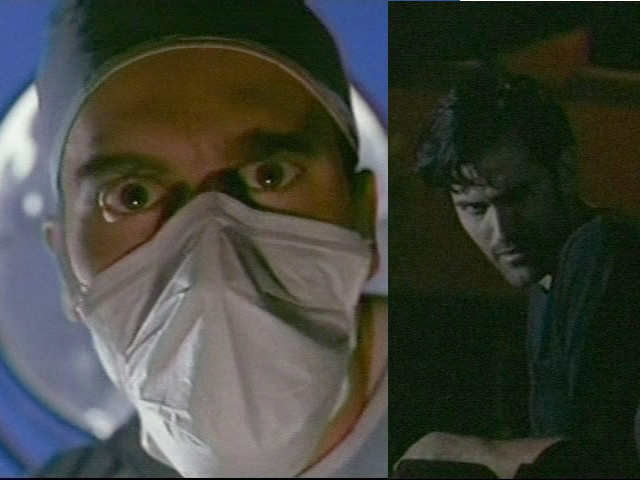
“I’m your producer. I’ll be in just a few scenes to trick you into watching this movie.”
Bruce Campbell also plagues the movie’s love interest, in the form of her sleaze-ball boyfriend Ray. Nancy is played by Deborah Foreman, known in my circles for portraying Muffy in the original “April Fool’s Day”. In that, she had a juicy, low-budget role, getting to play the mysterious hostess of a rapidly unravelling island vacation. Here, she is relegated to cringing and looking gooey-eyed as events require, and to Foreman’s credit she plays the part like a trooper.

Both actress and character are having second thoughts.
More on that later. The important thing, plot-wise, is that she feels responsible for everything that goes wrong around her. So these are the promised lunatics: a paranoid schizophrenic (I guess?) and a self-appointed scapegoat. Notice that one is an incurable psychosis and the other is, at best, a deep but treatable neurosis.
After Ray dumps Nancy, stranding her in L.A. with no money and an unpaid hotel bill, she winds up wandering the streets until she runs into a gang that wants to rape her. Managing to hide in a phone booth, Nancy winds up answering the phone. On the other end is Hank, who thinks he’s contacting a prostitute. Thus the lovers are set on their lunatic path.
Let’s talk about the giant spider. It’s why I watched it after all, and it’s more pleasant than other things I have to say. The spider shows up near the climax, when Hank has actually left his apartment in order to find Nancy. Nancy has run away from him, because he knocked her out in a delusional fit and is generally, you know, unstable.
You know what? I’ll get to the spider in a bit, but I have to deal with the elephant in the room, because this movie makes me hate myself. This is a Nice Guy story. No matter what he does, no matter his failings, no matter his prospects, no matter his sanity, Hank will win the girl like a prize for simply not being completely horrific. As a young man, this type of thing appealed to me a great deal. I’d actually get upset at movies where the heroine didn’t fall for the Nice Guy simply because he was present. How dare Andie pass on Duckie simply because she wasn’t attracted to him?
Nice Guy movies enforce this notion that women have no agency; that their love goes to those who simply aren’t horrific. This is different from Chaplin in “City Lights”, who goes to great lengths to cure his love’s blindness but then avoids her because he doesn’t want to burden her with his poverty. It’s different from Moranis in “Little Shop of Horrors”, who gives up everything he believes makes Audrey like him in order to save her. These men misjudge the women, who already love them for who they are. Nice Guys just have to be in position for a woman to land on them.
What he have in Hank is a horror show of a Nice Guy. He’s a jobless shut-in with a serious psychosis, who acts out violently during delusional episodes. On the plus side he writes truly awful poetry. After chasing Nancy out of his apartment, stalking her, and needing to be saved from a garbage truck by her (we’ll get back to that), Hank manages to knock out the lead gang member. For this one act Nancy is his. Nancy, who managed to elude and often defeat all threats until the finale, is a trophy Hank earned by leaving his apartment.
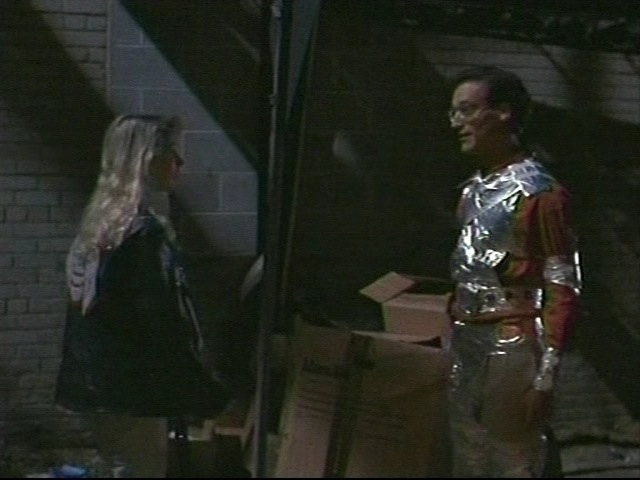
“I’m ready for my participation trophy!”
I could dismiss this as simply inept writing (which it is) but for the fact that I know I would have loved it if I’d seen this when it came out in 1991. It’s Ted Raimi being silly! Haha, crazy people! Happy ending — woot! My disappointment in my younger self is so great that I simply can’t remove it from discussion of “Lunatics: A Love Story”. I can’t be objective and leave it at saying that the script is built on clumsy cliches and expectations and that the humor is droll at best and plodding in general. I can’t distance myself enough to just say that the movie treats Nancy poorly. I can’t, because the movie puts my cultural misogyny in my face and expects me to find it funny. It’s repellent to me in a way that mere shoddiness and laziness of craft never achieves.
So, now that I’ve explained why I would never recommend this film to anybody, I’ll move on to the part I mostly liked. Hank is running around looking for Nancy, who’s running away from the rape gang. When he leans up against a wall, an insectile leg reaches down toward him. It’s a big goddamn spider, and it chases Hank down the street in some neat stop motion sequences. In reality, Hank is running away from a garbage truck, and why Nancy shoots at it for him I will never figure out.
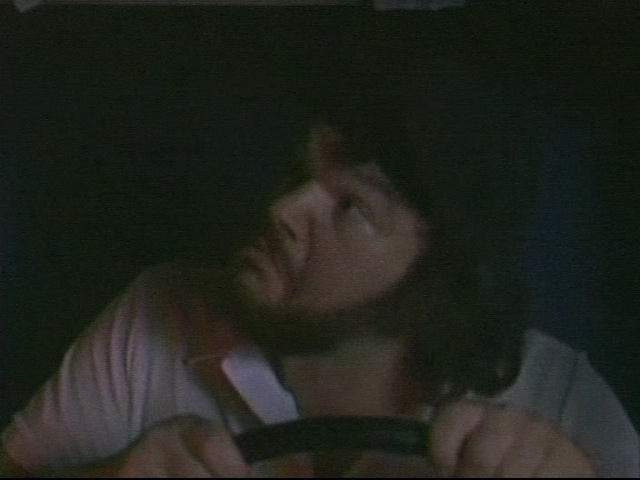
“What the @&$# did I do?”
I won’t say that this scene made the movie worth it, but between it and the trio of rappers who appear in Hank’s apartment I at least had a few moments of genuine enjoyment. I love stop-motion, and this is better quality than the movie required or deserved. It’s done by David Hettmer, who also worked on “Army of Darkness” with Renaissance. The animation is fun, and while the “spiders in the brain” scene is more memorable (by virtue of being over-the-top) it’s a treat watch the giant spider chase Hank down the street.
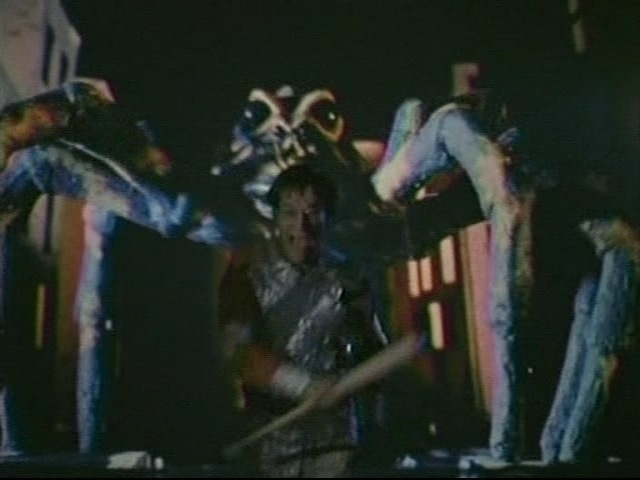
“Come back! My babies are in your brain!”
I can’t wrap this up without expanding on the rappers in Hank’s apartment. While the animated spiders were cool, the highlight for me was when these guys showed up. Early in the movie, Hank turns on his radio and these guys appear in his living room performing the LoDuca penned “Saran Rap”. This is a delightfully specific song about the spiders crawling in Hank’s mind, and I wish to hell that it was available to purchase. It’s a more threatening delusional episode than a mad surgeon, because it’s basically Hank materializing people to mock and berate him. Accusing yourself is a big part of mental illness, so I was glad to see the movie veer somewhat near the neighboring state of authentic symptomatology, if only for a moment.

The only non-whites in the film who aren’t rapists are a hallucination.
Becker went on to a minor career, directing episodes of “Xena: Warrior Princess” and “Jack of All Trades” as well as the TV movie “Hercules in the Maze of the Minotaur”. He co-wrote and directed the Bruce Campbell vehicle “Alien Apocalypse” and directed “Harpies”, starring Stephen “Not Alec” Baldwin–both of which play occasionally on SyFy instead of content. What I’m suggesting is that his work is serviceable but neither outstanding enough for bigger movies nor expedient enough for steady work. It’s hardly surprising, then, that “Lunatics: A Love Story” is a rough without any diamond.
1000 Misspent Hours: Mari-Cookie and the Killer Tarantula
There’s a movie that’s been passing around my circle of friends, testing their mettle and their willingness to continue speaking to me. It’s a movie that I discovered because of my fascination with two things: big damn spiders and the nearly contractual obligation for Linnea Quigley to remove her clothing on camera.
The movie is a DTV Jess Franco production, amusingly titled “Mari-Cookie and the Killer Tarantula in Eight Arms to Love You”. It’s the story of a were-spider (Lina Romay) who, well, has a lot of sex. It’s the sort of cinematic effluvium that defies description, but El Santo of 1000 Misspent Hours and Counting came the closet to explaining the experience of watching Mari-Cookie and the Killer Tarantula in Eight Arms to Love You.
I’ll eventually post my own review, someday when I can bring myself to watch it again.
Checkpoint Telstar: Earth vs The Spider (1958)
The Cold War movie review site Checkpoint Telstar is running a series of horror reviews this month for its HubrisWeen celebration — 26 reviews (A to Z) leading up to Halloween.
Day 5 is a review of the classic Big Damn Spider movie “Earth vs The Spider”, directed by serial BDS user Bert I. Gordon. It’s one of our favorites here in the Web, and Telstar is one of my closest friends, so I hope you’ll give it a read.
“Earth vs The Spider” on Checkpoint Telstar
See ya in the Web!
The Black Scorpion (1957)
Written by David Duncan and Robert Blees
Directed by Edward Ludwig
Giant critters were a staple of the drive-in fare of the late 1950s. “Tarantula”, “Them!”, “The Beginning of the End”, and so many others — the genre consisted largely of forced perspective filming, footage of animals super-imposed over actors, and the occasional puppet. In these standard techniques “The Black Scorpion” falls squarely on its drooling face. Where it excels is in the superb use of stop motion animation for the majority of its creature effects.
The film opens on stock clips of volcanos and earthquakes as a narrator ponderously explains the setup. He tells us that before forces that are “the most violent of modern times”, the people of Mexico can only pray. (Cue prayer footage.) A new volcano is formed, he tells us, and it grows 9000 feet in only a few days!
No one will be seated during the rather bland opening credits.
When the opening credits end, we see a jeep hauling a small trailer through the wasted landscape. The vehicle stops, and our male leads climb out to drop some exposition. Hank Scott is an American, visiting Mexico through the courtesy of Professor Artur Ramos. They are geologists who’ve driven through the destruction for three days to reach the new volcano. Amid all the waste lies a literal sign of life: a road marker which (if somehow still close to its standing position) indicates that they are 117K from Mexico City1 and only 12K from San Lorenzo. There are also indications that at least one other vehicle has been through here recently.
Continuing their journey, Ramos and Scott come upon workers repairing phone lines. These men affirm that San Lorenzo is near but haven’t heard how the town has fared in the wake of the disaster. The bridges might be out, they warn. A police car that headed that way never came back, though, so it’s possible that the route is clear2. The geologists thank them and continue their thrill-a-minute drive.
They locate the police car in a tiny deserted village. The car, and pretty much everything nearby, has been demolished. They can’t tell by what, but it may be related to that buzzing sound… Scott and Ramos find one survivor (a baby) and one victim (the police officer). They use the police radio to call in their discoveries then continue on to San Lorenzo, where military assistance should arrive the following day.
A crowd greets them in San Lorenzo, and after handing the baby to a nearby woman our heroes join Father Delgado for some dinner and expository dialog. It seems that in the aftermath of the eruption there have been other disappearances and unusual destruction. When victims have been found, their bodies are bloodless and their faces frozen in fear. Largely fueled by rumors from local caballeros, the masses believe it to be the work of a demon bull3.
Of course, none of this dissuades our intrepid duo from heading ever closer into danger. The following day, against the advice of Major Corsio (head of the newly arrived army unit), our action geologists continue driving toward the new volcano. They meet up with Teresa Alvarez, owner of the Alvarez ranch (whose cattle herders have fled, fearing the demon bull). Ramos discovers a sheet of unearthed shale, and after a lot more exposition and a meal the plot finally lurches begins in lugubrious earnest.
If you think I didn’t care for this movie, you’re partially correct. The pacing is atrocious, the plot meandering, and the direction tepid. I’ve seen far worse, but on a scale of “Unwatchable” to “Play It Again Now!” I would give it an honest “Well I’ve Seen That Now”… except. Ah, except for the wonderful, animated scenes of giant scorpions and other critters!
The great Willis H. O’Brien (“King Kong”, 1933) designed and supervised the effects, and his protegé Peter Peterson handled the actual animation. There are a few major set pieces, and they are a joy to behold: the lost underground world, the train tracks, and the stadium. The scenes at the train and stadium feature a lot of giant scorpion on vehicle violence and even the grisly demise of a few animated people. They’re a fun treat for fans of stop motion animation.
The reason I’m writing about this movie is what happens deep underground. Amid all the seismic activity of the eruption, an entrance opened on a world that had been sealed underground since pre-history — an enormous set of caverns in which monsters live brutal lives. It’s down here that Juanito meets a trap-door spider roughly the size of a brown bear.4

Wait. Six legs? We found the spider that everyone in “Camel Spiders” kept talking about!
“Wait”, you cry. “Who’s Juanito?”
Remember Teresa Alvarez, whose caballeros believed in a demon bull? Juanito is a servant boy on her ranch, and it is truly unfortunate that he stuck around. Whenever he’s told to stay put, he immediately sneaks off to run straight toward the scorpions. It’s amazing to me that nobody ever thought to tie Juanito down.
Naturally, when Ramos and Scott decide to descend into the crater via a lowered cage, Juanito tags along. This, immediately after being discovered hiding in the jeep, whereupon he had once again been told to stay the hell put. Somehow, two scientists fail to detect the child during a twenty-minute descent in a cage the size of a closet. Once they reach the bottom, the men tramp off, leaving Juanito to find some danger — which he does with a quickness!
Juanito leaves the safety of the cage and wanders directly to the lair of a big damn spider. This kid is so determined to die that he actually tugs at the spider’s trap door! Naturally, Ramos and Scott must rush over to save him. Mercifully the action soon moves to Mexico City, and the plot is no longer propelled by Juanito’s self-destructive urges.
This spider is an odd one. For one thing, it only has six legs. That’s assuming that the front appendages with pincers are pedipalps, which they would be on a scorpion. Additionally it doesn’t exactly leap out of its tunnel, which sadly allows Juanito plenty of time to get running. If we’re to assume any attempt at historical accuracy it could be that this arachnid is from a lost family of the sub-order Mesothelae, but it seems unlikely that much thought went into it.
With limited time and budget O’Brien and Peterson put the main effort into the scorpion models, which are excellent. The spider and another creature (a sort of worm with arms) are left over from O’Brien’s work on King Kong! They were two of the monsters at the bottom of a ravine, in one of the most famous cut scenes in the history of cinema. It’s neat that they were pressed into service again a quarter of a century later, but their design esthetic does not sit well alongside the more modern work.
Budget is the enemy of many films, but its lack is painfully visible here. The super-imposing process of the 1950s was labor intensive, and there was just too much to do. The result is a number of scenes that show the silhouette of a scorpion over running crowds. This is the matte over which the animation was to be placed, and it doesn’t look good on its own.
The other thing that looks bad is the scorpion head used for close-up shots. O’Brien supposedly supervised all of the effects, but he must have been looking elsewhere when this puppet was made. All of the realism and artistry of the animation models is completely absent here. It has a goofy, gaping maw that’s constantly drooling and googly eyes, and it looks nothing like the creatures taking apart trains and pulling helicopters out of the sky.
Hampered by a meandering script and budgetary constraints, “The Black Scorpion” nonetheless marks a high-point in arachnid cinematic effects. Far superior to most puppets and better than low-budget CGI, it’s a shame they weren’t part of a worthier movie.
FOOTNOTES
1. It is actually far from ludicrous to imagine a volcano appearing so near Mexico City. The city lies in the path of the Trans-Mexican Volcanic Belt, which forms a roughly latitudinal line across the country. There is even an active volcano only 40-some miles away. I will not speculate as to the odds of the spontaneous generation of such a massive new volcano in the region, but I think that the side effects of such an event would be catastrophic enough without adding giant prehistoric scorpions into the equation.
2. Whenever a character thinks that someone never returning is a good sign, I can only marvel at their innocence. If I go two hours without hearing from someone, I assume they’ve been eaten by dingoes.
3. Sadly, the legend of the demon bull is largely glossed over. It seemed far more plausible than the actual danger presented.
4. Nope. I’m not invoking the scorpions-are-arachnids clause to justify including this movie in the Big Damn Spider canon, although scorpions are way closer to spiders than whatever the heck this creature is. It only has 6 legs, so maybe it’s an escapee from “Camel Spiders”.
 Web of the Big Damn Spider
