
Genuine: The Tale of a Vampire (1920)
Directed by Robert Wiene
Written by Carl Mayer
Starring Fern Andra, Hans Heinrich von Trawdoski, and Ernst Gronau
I love expressionist fonts so very much.
In 1920, Robert Wiene’s The Cabinet of Dr. Caligari stunned audiences with its dark fairy tale about a sleepwalking killer. That year also brought the release another Wiene film of eerie murder, which has fared less well. Genuine, as it is currently available, is only 43 minutes long. The fullest version resides in a museum, but has not been made generally accessible. This presents difficulty for reviewing purposes, as it’s not representative of actual finished product. Still, I can comment on what we can see of the film.
The title is the name of the film’s antagonist. Genuine hails from Deep Tribal Landia, where a title card tells us she was a “priestess of a religion full of strange rites”. Her tribe loses a war, and she is put on the slave market. Creepy old Lord Melo buys her, despite warnings about her wildness. Melo places Genuine in an elaborate underground cage where he can adore her in private. What follows is a tragedy made of the broken bad plans of several people. Of principal importance to events are Melo’s grandson Percy and Florian, the nephew of Melo’s barber.
There are some rather ugly and unfortunate elements to the story of Genuine. To start with, we have the all-too-common motif of white specialness in a black society. Genuine is a priestess, an elevated position within the otherwise dark-skinned tribe. This is typical of Western literature seeking to exploit a “savage” setting. The important person had to be white, because colonialism and racism and audience empathy. I must admit that this puts a twist on the standard approach, as the primal nature of Genuine is to be feared rather than celebrated. Tarzan, Liane, and uncounted others are superior to civilized people because of their guilelessness and honesty. Genuine’s wildness, however, makes her the antagonist.

Florian is about to meet the girl of his nightmares.
While the danger that Genuine presents sets the stage for good dramatic tension, it creates another problem for the modern viewer. As the only woman seen outside of the slave market, Genuine is not merely an individual. She is the only example of female behavior in the world of the movie, and her example is one of destructive cunning. Not exactly progressive, but what else do you expect from 1920? She’s even tamed by Percy, through no particular effort on his part. Then, of course, the mob of angry villagers comes.
Genuine isn’t a bad movie, for its time. It’s nice to see more of Wiene’s output, especially from so close to his most enduring work. The sets are wonderful, and if you like silent film pantomime (which I do!) the acting is delightful. Sadly, it’s just not a compelling story. Also, she is not a vampire, no matter what the subtitle says.
Frankenstein (1910)

Written and directed by J. Searle Dawley
Liberally adapted from the novel by Mary Shelley
Starring Augustus Phillips, Charles Ogle, and Mary Fuller
Odds are that Edison didn’t even know this was being filmed.
The earliest known film version of Frankenstein; or, the Modern Prometheus was a short produced by Edison’s movie studio in 1910. Relating the complex tale of creation, abandonment, and revenge in less than a dozen minutes cannot be done without some vigorous editing of the story. Even Universal’s iconic adaptation practically rewrote the entire thing, and it had an entire additional hour to work with! Where the 1931 film used a simplified narrative to decisively shift any and all sympathy to the Monster, this version has no such gambit. So much is stripped away that there’s no genuine conflict at all.
The plot of the film, barely summarized: Frankenstein goes away to college. Two years later, we’re told via card, he has discovered the secret of life! He writes a letter to Elizabeth to inform he that he’ll be returning to marry her just as soon as he makes a perfect man. He makes a rather imperfect creature, flees to his bedroom, and faints. The Monster lams it. Frankenstein returns home and furthers his plans to wed Elizabeth. After talking to her in a parlor, he is startled by the appearance of his Monster. The Monster is startled by its appearance as well, finally getting a look at itself in a large mirror. It hides when Elizabeth returns to the room and waits while Frankenstein ushers her out. Once they are alone, man and Monster wrestle — but only until the Monster sees itself again and flees. Frankenstein and Elizabeth finally wed, and while Elizabeth prepares for her opening night as a Frankenstein, her husband wanders off. Cue the inevitable reappearance of the Monster, who we are told is jealous of Elizabeth. Elizabeth runs to Frankenstein and faints at his feet. The Monster comes after her and gets into an argument with its creator. For no clear reason it runs away just as Elizabeth awakens. We’re told that the “creation of an evil mind is overcome by love and disappears”. The Monster returns to the parlor where it sees its reflection once more. It vanishes, leaving its image in the mirror. Frankenstein comes in, and the Monster’s reflection is subsumed by his own. All is happiness and hugs in the house of Frankenstein.
Narratively, it’s unsatisfying; the ending is practically gibberish, and Frankenstein goes from evil to the purity of love in about a minute of screen time with no impetus or explanation. We’re simply told his evil created the Monster, and then that his love destroyed it. The Monster costume itself is… let’s just say it’s unimpressive. Fright mask, goofily long fingers and toes, and ragged clothing. The whole endeavor is shockingly bad in comparison to many other films of the time, and I have to wonder if there were bigger plans that got scrapped at the last minute.
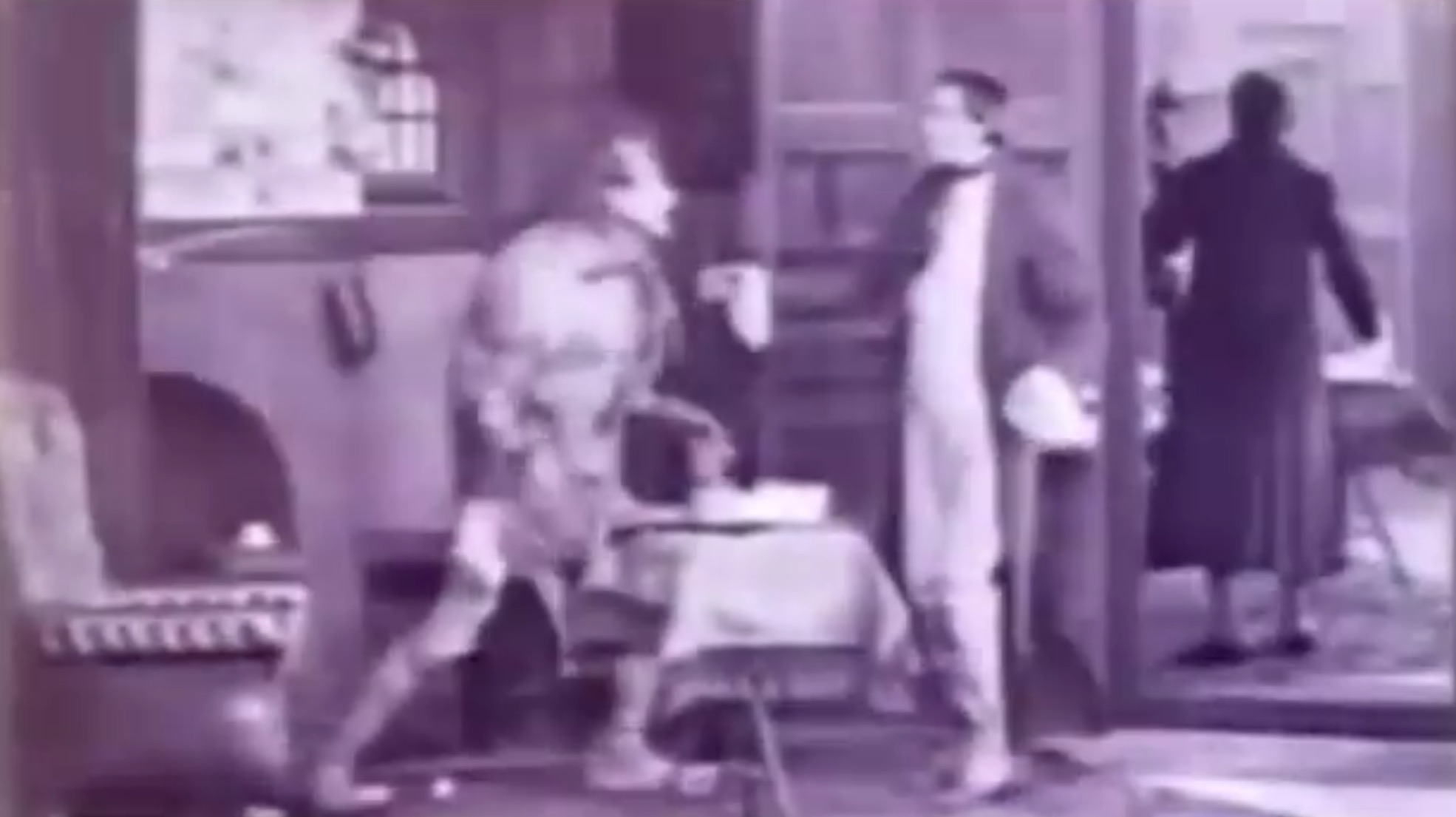
What if I slouched? Would you feel menaced then?
As the film stands there are only two reasons to watch it; three really, but two are pretty much the same. The first is historical interest. It was thought to be lost until a collector in the 1970s revealed that he’d purchased a copy from his mother-in-law 20 years earlier. So much has been lost of early film that a miracle like this shouldn’t be ignored. Closely aligned with this reason for viewing is simple curiosity. The Frankenstein Monster is a looming figure in Western culture and media. This is the earliest image of Shelley’s work being recorded for presentation to the masses. There was a play in the early 1800s, but this is where the tale lurches into a new age. No matter the film’s faults, that’s pretty damned cool!
Fortunately, there’s one more reason to spend the 10 minutes to watch this on YouTube. The creation sequence is ingenious if not also a touch unsettling. For whatever reason, Dawley decided that Frankenstein spent his two years in college learning alchemy. Chemicals are stirred in a cauldron, which is placed in a large kiln to cook. In a creepy bit of reversed footage, we see the Monster rise and form in fire. It’s a nifty effect, no less stunning for its simplicity.
It’s a shame that the next Frankenstein movie didn’t survive as well. It would be interesting to compare it with this one and see a little bit more of the path that led the definitive film version in 1931. Though Hammer later made Peter Cushing the superlative Frankenstein, it’s the Boris Karloff version that remains the definitive performance of the Monster.
Evilspeak (1981)
I await the sequels Evilhear and Evilsee.
Directed and written by Eric Weston
Starring Clint Howard, R.G. Armstrong, Joe Cortese, Richard Moll
The decade is changing over from the 70s to the 80s, and Happy Days is still on the air and a big part of the American mass media consciousness. Every knows who Ron Howard is, and he’s just started dabbling in movies. Problem is, you can’t get him for yours. What do you do? Hold on. Doesn’t he have a brother?
He does indeed. Clint Howard is Ron’s younger brother, and in my opinion the better actor. He takes more interesting roles anyway. Case in point: Evilspeak, in which he plays an unpopular cadet in a military academy. That’s an understatement. Stanley is despised by some of the other students. He’s an easy target — orphaned, poor, clumsy, short, a bit chunky, and already balding. All of that except for orphaned, poor, chunky, and balding applied to me as a kid, so of course I identify with Stanley.
That’s what makes this film so interesting. Because this is one of those horror films were the protagonist is the monster. Like poor Lawrence Talbot, you just can’t side against him even as he’s killing people. Unlike the Wolf Man, Stanley thinks he knows what he’s doing.
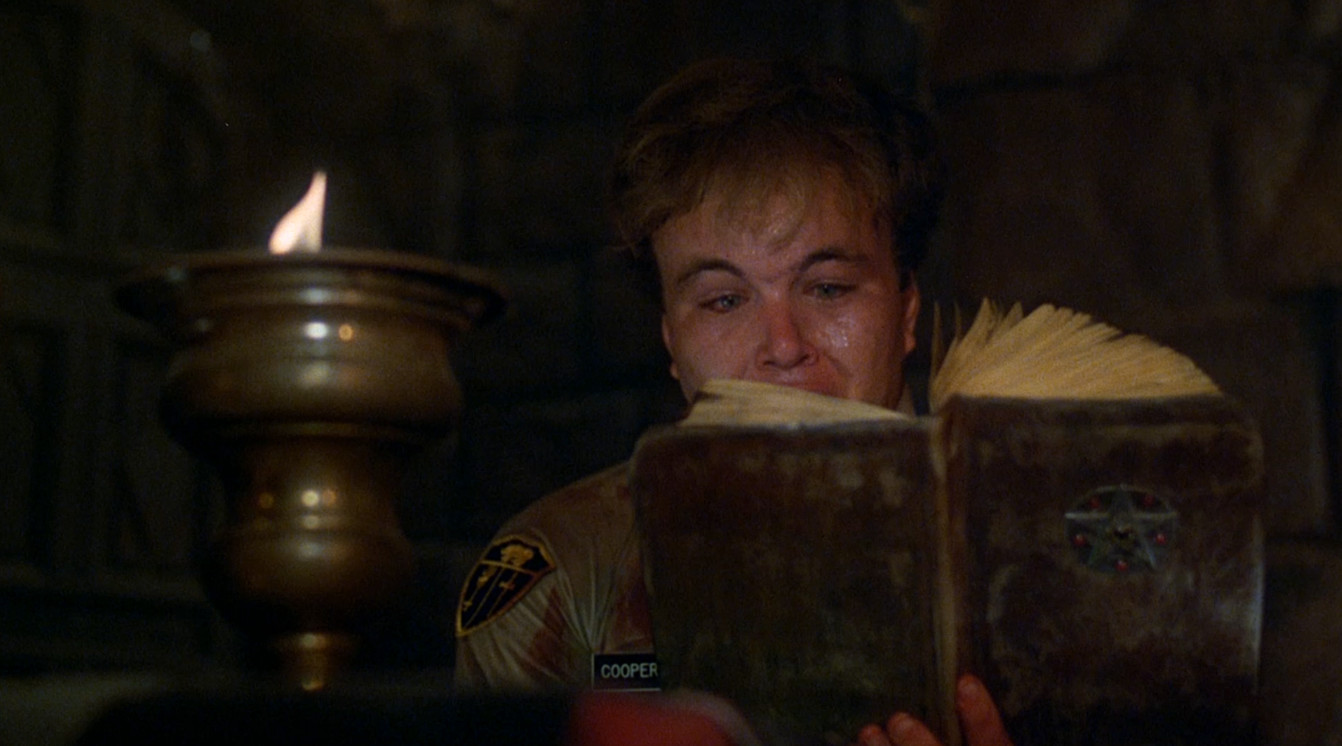
“Let’s see, next enter the command GOTO m_hell…”
Let me back up. See, Stanley gets punished for being the target of bullies, and he’s ordered to clean the cellar of the church on campus. Nothing good comes from cleaning church cellars, and sure enough Stanley finds a hidden room and an ancient tome. Fortunately it’s in Latin, so he can’t do anything stupid like read it aloud. Too bad he’s a geek, who can make a crappy terminal computer translate it. It is, of course, a book of dark magic; left in this case by Father Esteban (Richard Moll), excommunicated from the Catholic Church and exiled from Spain centuries ago. Stanley’s terminal plugs into Esteban, and before you can say “angry nerd” Stanley is a dark sorcerer unleashing unholy Hell on campus.
Evilspeak attained some notoriety from being on England’s “Video Nasties” list of banned films. It’s bloody and Satanic, and it’s impossible to take seriously. It is also quite a bit of fun, and better than you might expect from such an oddity. Just don’t watch it on your computer, though. You never know.
Devil Dog: The Hound From Hell (1978)
Directed by Curtis Harrington
Written by Stephen and Elinor Karpf
Starring Richard Crenna, Yvette Mimieux, Kim Richards, and Ike Eisenmann

The Cur of Cute
In August of 1977, David Berkowitz was arrested for the “Son of Sam” murders — so-called due to a bizarre note found at one murder scene. He admitted to the killings, claiming that his crimes were ordered by a demon (a black lab named Harvey) kept by his neighbor (Sam). The outlandish confession caught the public’s attention by the throat, fueling debates about legal insanity and inspiring laws to prevent convicted criminals from selling their stories.
I would contend that it also planted the idea of demonic canines in the fertile imaginations of writers. The following year saw the release of Albert Band’s Dracula’s Dog, and only three years later Stephen King unleashed Cujo. Yet the most explicit connection to Harvey the demon pooch is Lucky, the cuddly threat of Devil Dog: The Hound of Hell. Filmed for television, Devil Dog first aired on Halloween in 1978. It’s a good feature to hand out candy during, being both fairly ridiculous and sporadically interesting.
The premise is that a satanic cult distributes demonic puppies to unsuspecting suburban families. Once established within middle-American families, the pups corrupt their homes. The details are vague, but somehow this scheme aims to break the Beast’s 1,000 year confinement. I took careful notes, but I’m afraid it defies all attempts at logic.
The cultists first acquire a proven breeder dog. They want her immediately, and she must be in season as it were. They’ve had an entire millennium to prepare for this, but some people will always leave everything to the last minute. The next step is to summon a barghest in a dark ritual. (A barghest is a mythical creature from Northern England that takes the form of a large black dog.) From such humble beginnings, more barghest pups are sired. Once weaned, the creatures will spread corruption. There’s a missing step that connects that to the final step in their plan, wherein the Beast roams the Earth. More on this confusion later.
The film follows the Barry family, who’ve taken a young demon puppy into their home after the suspiciously-timed death of the family dog. Specifically it follows Mike Barry as Lucky collects the souls of his family. Mike is played by veteran actor Richard Crenna, whose professionalism helps ground the film. The Barry children are portrayed by Kim Richards and Ike Eisenmann, the young stars of Escape to Witch Mountain and Return to Witch Mountain. Their comfort with each other and experience working with animals come through here, lending credence to some rather unusual moments. Indeed, the pair of them are often more threatening than the barghest.

It might be easier to list what’s less terrifying than a puppy.
The family barghest is first played by an absolutely adorable puppy. Despite the best efforts to splice shots of Lucky into horrific events, it only serves to undercut the tension and danger. Sure, someone’s burning to death, but look at that sweet face! The adult Lucky is a little less cute but still appears friendly. There’s hardly a shot of the dog where its tongue isn’t hanging out, and sometimes the embodiment of evil sits on its right haunch as though unwilling to fully commit to the corruption of the nuclear family. When the barghest’s true form is revealed to be Lucky in dark paint and a black feather boa, you have to give credit for simply trying anything.
Part of the difficulty of making the dog scary also lies with the jumbled mythology that’s presented. The use of a barghest is pretty cool and should be enough to carry a horror movie in itself, but the demon litter is supposed to lead to the release of the Beast. At times this seems to be the Beast from Revelations, but it’s also a non-specific 3-eyed demon. The children draw it in blood, but when shown this portrait an occultist’s only observation is that 3-eyed ones are clever. A photo of an entirely dissimilar demon drawn on a cliff sends Mike to Ecuador, where a shaman ties it all back to Revelations again. What nobody manages to do is explain what the barghest has to do with anything. A less apocalyptic plot could have helped focus the story and create some actual tension.
Another detriment to establishing any sense of danger is that nearly every event in the movie is completely self-contained. Aside from the presence of the barghest and the corruption of the family, much of the film is comprised of plot chunks so complete and modular that they could be removed without any damage to the structure. One notable example is the matter of the school election. In one scene, we learn that young Charlie is running for class president. In the next scene, a teacher comes to say that he’s concerned about how Charlie won (by framing his opponent for stealing). Then Lucky kills the teacher. Most of the supporting roles follow this pattern, with the characters being introduced and discarded within minutes.
While this doesn’t add up to a good movie, it is an enjoyable one. The episodic construction means that something new and different happens every ten minutes, which helps keep it fresh. It also allows whole sections to be missed with little cost to comprehension. Watching the actors come and go is entertaining, and it’s just plain fun to see the dog be utterly harmless.
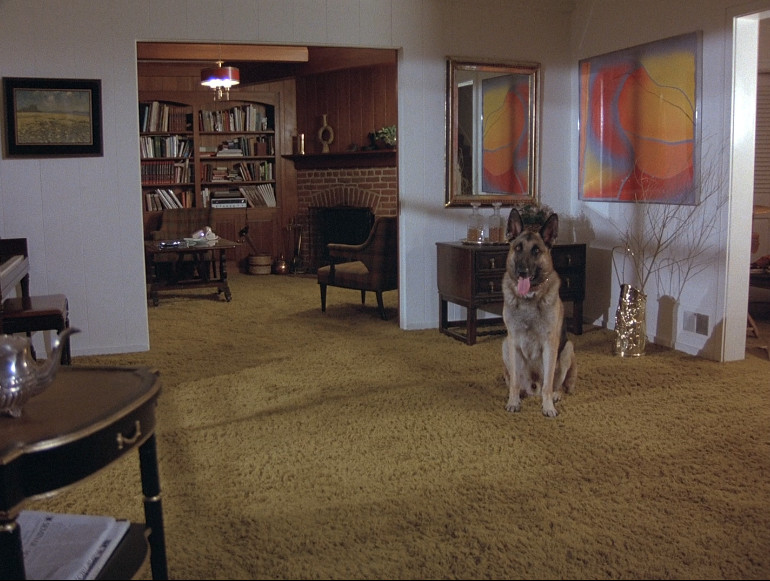
Are you scared yet?
I would be remiss if I neglected to mention the scene that directly connects the film to David Berkowitz’s confession. While Mike is considering whether he can actually believe that the family dog has been turning everyone into Satan’s tools, he catches an item on the news that seems connected. A reporter is interviewing a woman whose husband has just been arrested for murder. According to her, her husband had claimed that the dog next door had made him do it. Airing just over a year after Berkowitz’s arrest, this is no coincidence. Ultimately, that may be the most compelling reason to watch this — to see the slap-dash TV cash-in of the “Son of Sam” confession.
The Car (1977)

The simple title.
Directed by Elliot Silverstein
Written by Dennis Shryack, Michael Butler, and Lane Slate
Starring James Brolin, Kathleen Lloyd, John Marley, and Kim Richards
Some movies carry a deep message. They seek to make us wiser, or at least to think for at least a little bit. They may be cringingly obvious, like the delightfully silly rock-and-roll biblical allegory The Apple; or they may be immersive and well-crafted, as in A Girl Walks Home Alone At Night. Then there are movies that never reach beyond their high-concept premise.
The Car is a movie of the latter ilk, and the only thing it asks of its audience is to accept that a car just really likes killing people. Sure, there are characters. After all, the car needs victims. There’s even a main character: Wade Parent, played by James Brolin. Parent is a deputy sheriff who has to protect his community, his children, his girlfriend, and his officers from the car. Without revealing which people he fails, I’ll just observe that this was made at a time when the most common special effect was a police car getting wrecked.

The car crashes practice at the parade grounds.
Ultimately, while the film centers on Sheriff Parent’s efforts, it’s clear that the car is the star. It’s not just randomly running people over, although it is often opportunistic. It kills the sheriff early on for trying to wreck its fun, and a person who taunts it from a position of safety is explicitly targeted for vengeance later. It’s playful too, like a house cat tormenting mice. We don’t know where it came from, and we can only guess that it’s somehow satanic (it can’t enter holy ground), and these mysteries grab our attention. Like the graboids in Tremors, the lack of explanation only heightens the immediacy of the threat.
I confess that my first reaction on seeing this one was that someone had filed the numbers off of Stephen King’s Christine. Demonic car, indestructible, taste for blood — there’s a certain conceptual similarity, you’ll admit. In fact, this came out about five years before King’s book and the subsequent John Carpenter film adaptation. Moreover the stories come from different places. King’s story was about the relationship between people and their cars. Yes, the car was possessed and evil, but it gained power through the love and attention of its owner. The car in this movie does not need anybody. It runs on nothing but its own desires to kill.
Maybe that’s the meaning of The Car. There are threats we cannot understand, enemies with whom we cannot reason, and when that happens, you’ll need to have one hell of a mustache.
Blood and Lace (1971)
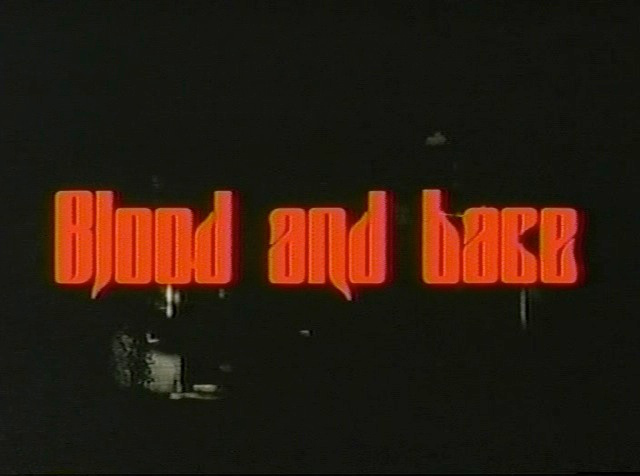
You want to make the title as difficult to read as possible.
Directed by Philip S. Gilbert
Written by Gil Lasky
Starring Gloria Grahame, Len Lesser, Milton Selzer, Vic Tayback, Melody Patterson
Blood and Lace is the only credit for director Philip Gilbert, possibly because future potential backers knew about it. If you’re the sort who appreciates a trigger warning, consider this your chance to bail. This film ups the offensiveness every ten minutes or so, managing to miss only a very few sensitive areas. They don’t show any necrophilia, for instance, although it’s admittedly possible that some of that was going on off screen.
The premise is straightforward enough: when her mother is killed with the claw end of a hammer, Ellie Masters (Melody Patterson) is placed in the Deere Youth Home. The potential for her mother’s killer to come after her has to take third seat threat behind the murderous corruption of the orphanage and lecherous advances from the ephebophilic1 detective investigating the homicide. Detective Calvin Carruthers (Vic Tayback) is so blatant in his aim that even the other slimeballs in the movie think he’s gross. Even the handyman2 loathes Carruthers, and he tries to rape Ellie.
I did say “trigger warnings”.

Mrs. Deere believes in discipline. Also bondage and sado-masochism.
The orphanage is a standard-issue criminal enterprise. Food is meager, as funds from the county go to kickbacks and profit. Runaways are killed, or bound in the attic if they’re less fortunate. Bodies are kept in the freezer for head-count days. Details like this barely scratch the sleazy surface of this movie. It’s as though in every scene writer Gil Lasky pushed himself to be more vile and horrid. The movie stands as a testament to determined tastelessness, and it’s amazing to behold.
What’s truly startling is how many working actors agreed to be in this. Len Lesser, Milton Selzer, and Vic Tayback were prolific character actors before and after Blood and Lace, and Gloria Grahame wasn’t exactly in a slump. One wonders what Lasky and Gilbert had on them. The result is worth it though. All of the key adult roles are filled by experienced actors. In fact the overall production values far exceed what you might expect in such a venture. Even the severe burn makeup is acceptable for the time and presumably low budget. It’s evident that some actual care and workmanship went into this, which somehow elevates it above the over-the-top script.
If you’re okay with an implacable escalation into weird depravity, this can be a pretty fun movie. It even has some astoundingly human moments. At one point, when Mrs. Deere and her handyman are busy elsewhere, one orphan urges the others to run for it. Nobody moves, and one boy finally asks him “Where would we go?”
FOOTNOTES
1. Look that up at your own risk.
2. Len Lesser, in a role that will disgust you.
The Asphyx (1973)

Diected by Peter Newbrook
Written by Brian Comport from a story by Christina Beers and Laurence Beers
Starring Robert Stephens, Robert Powell, Jane Lapotaire, and Alex Scott
According to the movie, an asphyx is a creature of Greek legend that appears to those about to die in order end its own torment. This is glossed over rather quickly, as the “reality” is somewhat more complex. The true reality, of course, is that there’s no such recorded myth, which is a shame. School children would have been delighted to discover a creature whose name is pronounced like a repair to the posterior.
The Asphyx centers on the activities of Sir Hugo Cunningham (Robert Stephens), who has two preoccupations: the paranormal and the newly developed art of photography. Sir Hugo is quite inventive, creating his own lighting equipment with luminous crystals and dabbling in a slide-based motion camera with accompanying projector. His interests collide when photographs of people at the moment of death (taken by himself and two others) reveal a dark smudge near the body.
He and his colleague, Sir Edward Barrett (Alex Scott, who you may recognize from his roles in Twins of Evil and The Abominable Dr. Phibes), believe these photographs show the departure of the soul. When Sir Edward requests pictures of a hanging to use in efforts to ban executions, Sir Hugo decides to use the opportunity to further test his filming techniques. The light is dim, so he turns on his blue light. To everyone’s horror a hideous creature appears in the light. Even worse, the hanged man doesn’t die. Appalled, Sir Hugo shuts everything down in order to flee. The moment his light is turned off, the strange apparition vanishes and the convict dies.

“Iiiiiiii ain’t got no… booody!”
Here at length is the premise, and it’s a corker! In effect, The Asphyx is an exploration of how Frankenstein might have turned out if the Baron had gone into mad engineering instead of mad surgery. Their goals are identical: to conquer death. Both men are motivated by the tragic loss of loved ones, and both lose everything in their struggle against the inevitable. Only their methods differ. While Baron Frankenstein sought the medical spark of life, Sir Hugo pursues the spiritual cause of death. Death only comes from the arrival of an individual’s asphyx, so by trapping their asphyx a person becomes functionally immortal.
It’s a slow-paced but engaging story, filled with melodrama and the lamentable tragedies of hubris. Also lamentable are the effects, some of which are distractingly bad (I’m looking at you, Old Age Makeup). The plot depends on the asphyx, which looks like a muppet of a Fiji mermaid. They try to hide it in a fluttering projection, but it’s still just a sad puppet with floppy arms.
On the whole, I like this one a lot. The concept is neat, and there’s a terrific comeuppance scene to show Sir Hugo the error of his ways. It’s far from perfect — and there are some horrible contrivances — but it’s a good example of the horror of thought, which has largely given way now to the horror of viscera. I enjoy a good gut-slitting, but the movies that stay with me tend to be the ones that plant ideas in my head.
 Web of the Big Damn Spider
