
Blood and Lace (1971)

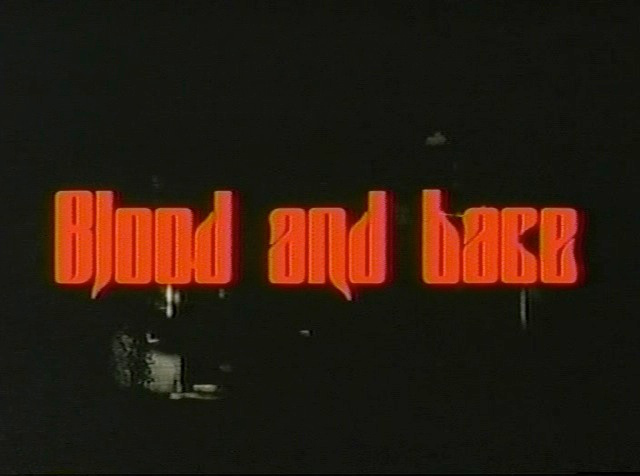
You want to make the title as difficult to read as possible.
Directed by Philip S. Gilbert
Written by Gil Lasky
Starring Gloria Grahame, Len Lesser, Milton Selzer, Vic Tayback, Melody Patterson
Blood and Lace is the only credit for director Philip Gilbert, possibly because future potential backers knew about it. If you’re the sort who appreciates a trigger warning, consider this your chance to bail. This film ups the offensiveness every ten minutes or so, managing to miss only a very few sensitive areas. They don’t show any necrophilia, for instance, although it’s admittedly possible that some of that was going on off screen.
The premise is straightforward enough: when her mother is killed with the claw end of a hammer, Ellie Masters (Melody Patterson) is placed in the Deere Youth Home. The potential for her mother’s killer to come after her has to take third seat threat behind the murderous corruption of the orphanage and lecherous advances from the ephebophilic1 detective investigating the homicide. Detective Calvin Carruthers (Vic Tayback) is so blatant in his aim that even the other slimeballs in the movie think he’s gross. Even the handyman2 loathes Carruthers, and he tries to rape Ellie.
I did say “trigger warnings”.

Mrs. Deere believes in discipline. Also bondage and sado-masochism.
The orphanage is a standard-issue criminal enterprise. Food is meager, as funds from the county go to kickbacks and profit. Runaways are killed, or bound in the attic if they’re less fortunate. Bodies are kept in the freezer for head-count days. Details like this barely scratch the sleazy surface of this movie. It’s as though in every scene writer Gil Lasky pushed himself to be more vile and horrid. The movie stands as a testament to determined tastelessness, and it’s amazing to behold.
What’s truly startling is how many working actors agreed to be in this. Len Lesser, Milton Selzer, and Vic Tayback were prolific character actors before and after Blood and Lace, and Gloria Grahame wasn’t exactly in a slump. One wonders what Lasky and Gilbert had on them. The result is worth it though. All of the key adult roles are filled by experienced actors. In fact the overall production values far exceed what you might expect in such a venture. Even the severe burn makeup is acceptable for the time and presumably low budget. It’s evident that some actual care and workmanship went into this, which somehow elevates it above the over-the-top script.
If you’re okay with an implacable escalation into weird depravity, this can be a pretty fun movie. It even has some astoundingly human moments. At one point, when Mrs. Deere and her handyman are busy elsewhere, one orphan urges the others to run for it. Nobody moves, and one boy finally asks him “Where would we go?”
FOOTNOTES
1. Look that up at your own risk.
2. Len Lesser, in a role that will disgust you.
The Asphyx (1973)

Diected by Peter Newbrook
Written by Brian Comport from a story by Christina Beers and Laurence Beers
Starring Robert Stephens, Robert Powell, Jane Lapotaire, and Alex Scott
According to the movie, an asphyx is a creature of Greek legend that appears to those about to die in order end its own torment. This is glossed over rather quickly, as the “reality” is somewhat more complex. The true reality, of course, is that there’s no such recorded myth, which is a shame. School children would have been delighted to discover a creature whose name is pronounced like a repair to the posterior.
The Asphyx centers on the activities of Sir Hugo Cunningham (Robert Stephens), who has two preoccupations: the paranormal and the newly developed art of photography. Sir Hugo is quite inventive, creating his own lighting equipment with luminous crystals and dabbling in a slide-based motion camera with accompanying projector. His interests collide when photographs of people at the moment of death (taken by himself and two others) reveal a dark smudge near the body.
He and his colleague, Sir Edward Barrett (Alex Scott, who you may recognize from his roles in Twins of Evil and The Abominable Dr. Phibes), believe these photographs show the departure of the soul. When Sir Edward requests pictures of a hanging to use in efforts to ban executions, Sir Hugo decides to use the opportunity to further test his filming techniques. The light is dim, so he turns on his blue light. To everyone’s horror a hideous creature appears in the light. Even worse, the hanged man doesn’t die. Appalled, Sir Hugo shuts everything down in order to flee. The moment his light is turned off, the strange apparition vanishes and the convict dies.

“Iiiiiiii ain’t got no… booody!”
Here at length is the premise, and it’s a corker! In effect, The Asphyx is an exploration of how Frankenstein might have turned out if the Baron had gone into mad engineering instead of mad surgery. Their goals are identical: to conquer death. Both men are motivated by the tragic loss of loved ones, and both lose everything in their struggle against the inevitable. Only their methods differ. While Baron Frankenstein sought the medical spark of life, Sir Hugo pursues the spiritual cause of death. Death only comes from the arrival of an individual’s asphyx, so by trapping their asphyx a person becomes functionally immortal.
It’s a slow-paced but engaging story, filled with melodrama and the lamentable tragedies of hubris. Also lamentable are the effects, some of which are distractingly bad (I’m looking at you, Old Age Makeup). The plot depends on the asphyx, which looks like a muppet of a Fiji mermaid. They try to hide it in a fluttering projection, but it’s still just a sad puppet with floppy arms.
On the whole, I like this one a lot. The concept is neat, and there’s a terrific comeuppance scene to show Sir Hugo the error of his ways. It’s far from perfect — and there are some horrible contrivances — but it’s a good example of the horror of thought, which has largely given way now to the horror of viscera. I enjoy a good gut-slitting, but the movies that stay with me tend to be the ones that plant ideas in my head.
 Web of the Big Damn Spider
