
The Visitor (1979)


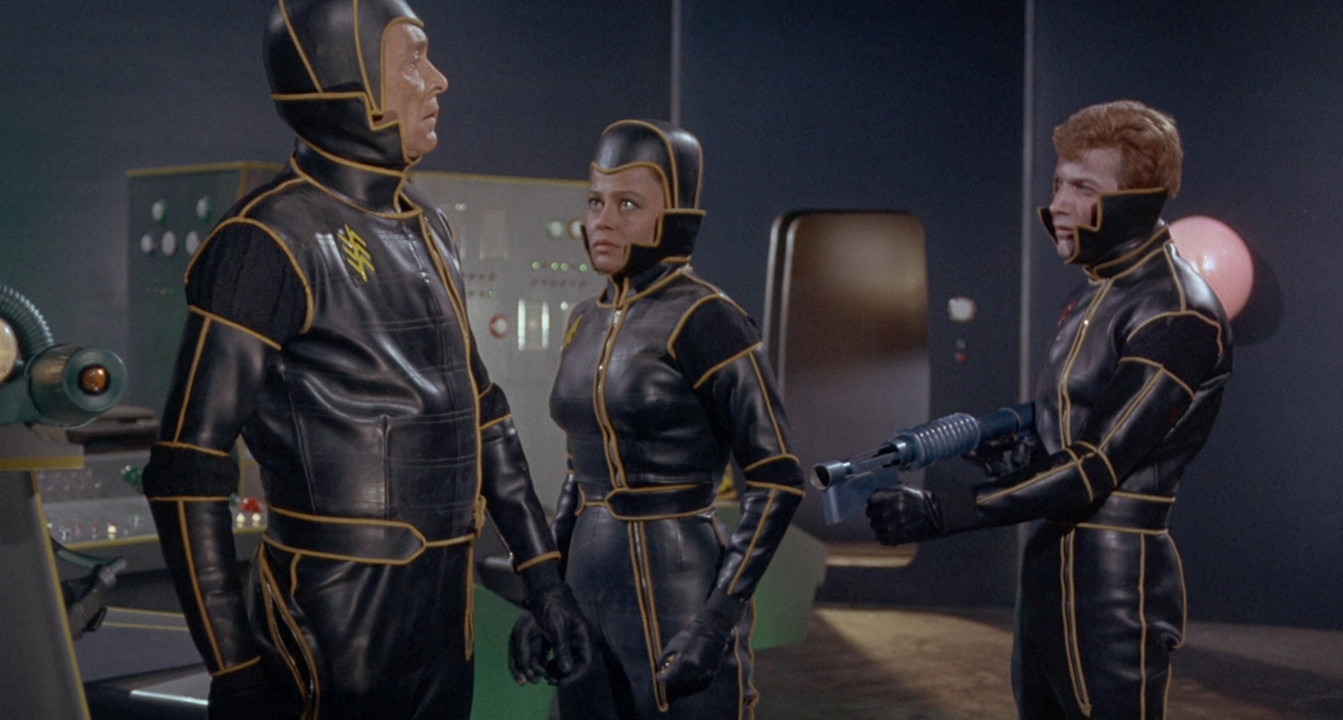
This title screen is too sedate and normal for this movie.
Directed by Giulio Paradisi
Written by Luciano Comici and Robert Mundi
Story by Giulio Paradisi and Ovidio G. Assonitis
Starring John Huston, Glenn Ford, Shelley Winters, Barbara Collins, Lance Henriksen, and Paige Conner
The Visitor is a movie that defies summarization. You can say that it is about a space angel coming to Earth to take a daughter of Satan to space Jesus for reform school, but that doesn’t get across a fraction of the crazy sauce that this movie has to offer. Lance Henriksen claimed that rewrites came in every day, to the point where nobody knew what the film was about anymore. I believe it, since it certainly plays out that way. Very few scenes seem to be connected outside of the reappearance of core actors. Then there’s the problem that nothing which happens during the majority of the film matters in any way to the conclusion. But I’m getting ahead of myself.
The film starts by telling us about the evils of Sateen, who will not be appearing in this film. We then see a basketball game. The owner of one team turns out to be Lance Henriksen. His money came from a secret organization that’s wants him to have a son with his girlfriend (Barbara Collins). She can bear children with the powers of Sateen, and her daughter already exhibits telekinetic abilities. The cult wants a breeding pair of Sateen spawn, which they somehow believe they’ll be able to control.
The only part of any of that which matters is that there’s a girl with major power.
Shelley Winters masquerades as a housekeeper to keeps tabs on the girl for another unnamed organization. She scolds and threatens and even slaps the girl, but it’s never relevant. Also not important is the detective that is trying to solve the “accidental” shooting of her mother. Nor are the people focusing their mental energies on a rooftop at the request of John Huston, space angel.

None of these people matter.
The only thing that matters — and you’ll want to skip over this if you want to save the anti-climax for your own viewing pleasure — is that John Huston sits down to play pong with the devil child. Yup. That’s it. That’s the final confrontation between good and evil. Pong. Okay, there are a few magic bolts and demon eyes, but basically after playing a video and deciding she can’t beat the angel, she surrenders and goes to Space Jesus Camp.
I love this movie. It’s awful, and it’s stupid, and things happen for no reason, and I love it for that. Every few minutes it’s a whole new set piece in which something horrible occurs. It’s a pre-1980s movie that’s made for the “MTV generation” of short attention spans and senseless visuals. You can pop this in at a party, knowing that nobody will miss anything by not paying attention but everyone will be rewarded for watching bits of it. Heck, make it a game to see if the group can reconstruct the plot from the different fragments they saw. It’s a goddamn treasure to have a movie like this that is better for being such totally entertaining crap.
Up From the Depths (1979)

They spent more on these titles than on the dubbing.
Directed by Charles B. Griffith
Written by Alfred M. Sweeney and Anne Dyer
Starring Sam Bottoms, Susanne Reed, Virgil Frye, and Charles Howerton
There’s nothing like box office success to spawn pale imitations, and Jaws is one of the most imitated films since Gaslight. Roger Corman probably produced about a third of them, but few are as terrible as Up From the Depths. A story has it that the script and soundtrack were lost, necessitating a reconstruction based on memory and lip-reading. I can certainly believe the actors storing their copies in the circular file after filming, but it seems far-fetched that none were available. Maybe revision pages. Anyway, the story would account for the terrible dialog and often lamentable dubbing.
Up From the Depths doesn’t even pretend to be anything other than a ripoff. The monster is basically a shark, just one that’s supposed to be in the deep sea. A lot of other deep water fish are turning up near the beach, but the movie is completely uninterested in giving a reason for that. Researcher Tom (Charles Howerton) was briefly curious until the unshark arrived. Now, even though the creature ate his assistant/girlfriend, all he wants to do is study the monstrous fish.
There is no festival to threaten with cancellation, but there is a bounty placed on the unshark by the manager of a hotel. In Jaws this led to people putting themselves in danger, mass confusion, and a lot of innocent sharks being slaughtered. Here, it’s just one of far too many excuses for “Hijinks and Hilarity”. A Japanese tourist puts on a towel that’s might be supposed to represent a sumo loincloth, grabs a sword, and marches off to the beach. A couple of people put on full diving gear in their room and walk backwards all the way to the beach because flippers. Hi-LARIOUS! Terrible comedy is my kryptonite, and this movie nearly finished me off.

They wisely keep the abyssal unshark in murky shots.
Credit where it’s due, the giant fish prop isn’t bad. We don’t see a lot of it, but the sight of multiple fins slicing through the water is effective and the brief glimpses of the unshark underwater are good enough to give an idea of what the cast is facing. Don’t expect any attack footage, though. It’s strictly lead up, bloody water, and aftermath. That’s probably for the best. There’s no telling how much damage the prop would have sustained in a full-contact scene.
I found it difficult to watch this movie. I’m not saying that it was offensive (other than the toxic attempts at humor), or that it made me tense. I kept becoming engrossed in anything else at hand — cats, Twitter, blowing my nose — because the film actively repelled my interest. Once I looked away during an interminable underwater scene, and when I looked back a character had died. I back up to see what I had missed only to find that all there had been was a quick shot of blood in the water. I shrugged and went back to rubbing my cat’s ears.
The Thing (2011)

Even the title effects are ripped off.
Directed by Matthijs van Heijningen, Jr.
Written by Eric Heisserer
Based on the short story Who Goes There? by John W. Campbell, Jr.
Starring Mary Elizabeth Winstead, Joel Edgerton, and Ulrich Thomsen
When John Carpenter took a stab at making a new film adaptation of John W. Campbell’s masterful story Who Goes There? he chose to name it after the first movie version. So he took the title The Thing From Another World and shortened it to The Thing. That’s pretty much all he took from the 1951 film that wasn’t part of Campbell’s story to begin with. Audiences had changed dramatically in 30 years, as had effects technology. The more modern take was a showpiece for practical effects, drawing on the ability of Campbell’s monster to imitate the crew of the Antarctic base to create grotesque hybrid forms for the thing to assume between masquerades. The two adaptations are both good, although in different ways that speak to their times. The first reassured us that American determination and scientific achievement would win the day, and the second warned us that the best we can hope for is mutually assured destruction.
That’s where the story could have ended, but another 30 years on someone decided to show how it began. Carpenter’s movie started with the thing arriving at the American camp in the form of a sled dog. A helicopter from the Norwegian base pursues it but crashes. When the Americans finally check out the other base, the find it in ruins with no survivors. This adds to the feeling of isolation while heightening the danger. We don’t need to see how the previous base got wrecked; it’s happening again. Well, someone felt that we really needed to see it after all, and thus the prequel to The Thing, imaginatively titled The Thing.
Remember when Gus Van Sant did a shot-for-shot remake of Psycho and the world yawned? This isn’t really the situation here, but it sure feels like it at times. Mediocre CGI replaces the phenomenal puppetry and stop-motion while attempting to look the same. Same ideas for combating the thing. There’s one small difference in identifying who’s still human, but it makes absolutely no sense. We’re told that the thing can’t copy inorganic material, so only humans would have fillings. Okay, but the thing also imitates clothing; including zippers, snaps, and synthetic fabrics. The only place the movie breaks truly free from failing to ape Carpenter is with the space ship.

Yup. Nothing human could try that hard to look like “Alien”.
Where the earlier movie started with the mystery of the Norwegian’s hunting a sled dog, this one starts with the Norwegian’s almost literally stumbling into the discovery of the space ship. Seen only through the ice before, here it is largely dug out. Yet with this potential for exploring something different, once the thing is discovered the ship is forgotten until the climax. The filmmakers took a lot of effort to set up and explain the appearance of the Norwegian camp in Carpenter’s film, and by all the mead in Valhalla you’re going to see every bit of that explanation, down to the smallest minutia.
Finally granting us entry into the alien vessel at the end, the film refuses to show much of anything. No hint of the crew, bones or personal items or anything. Just immaculate science fiction halls. The one chance to break free of merely attempting to attach itself to a superior film — to create its own identity — and it fails to deliver.
It’s not a terrible movie, and I have certainly seen worse even during the Hubrisween project. It’s just so unnecessary. Watching it, I felt as though I was seeing a detailed facsimile that wasn’t quite convincing. It just made me wish I were watching the real thing.
Satan’s Skin (1971)

This title has only slightly more to do with the movie than does this bird.
Directed by Piers Haggard
Written by Robert Wynne-Simmons and Piers Haggard
Starring Patrick Wymark, Linda Hayden, Barry Andrews, and Anthony Ainley
Tigon had the distinction of not being Hammer Studios. It wasn’t even Amicus, which produced movies that casual viewers mistook for Hammer. Still, with modest budgets Tigon was able to make a few of the more memorable British horror films of the 1960s-1970s. Witchfinder General showcases Vincent Price in his most purely villainous role, and The Creeping Flesh is an enjoyable monster flick featuring Peter Cushing and Christopher Lee as scientists combating evil itself. In my opinion, the studio’s greatest achievement was the 1971 satanic thriller Satan’s Skin, aka The Blood on Satan’s Claw.
Set during England’s interregnum, the action of the film takes place in a secluded village. An eerie humanoid skull, covered in clumps of fur, turns up when farmland is plowed. The bones go missing, and soon the youth of the village begin acting strange. They stop attending religious instruction and begin playing deadly games in the woods. Strangest of all, several grow odd patches of fur on their skin. It’s up to The Judge, local representative of order and modern society, to stop the Devil from assembling a new body on Earth.
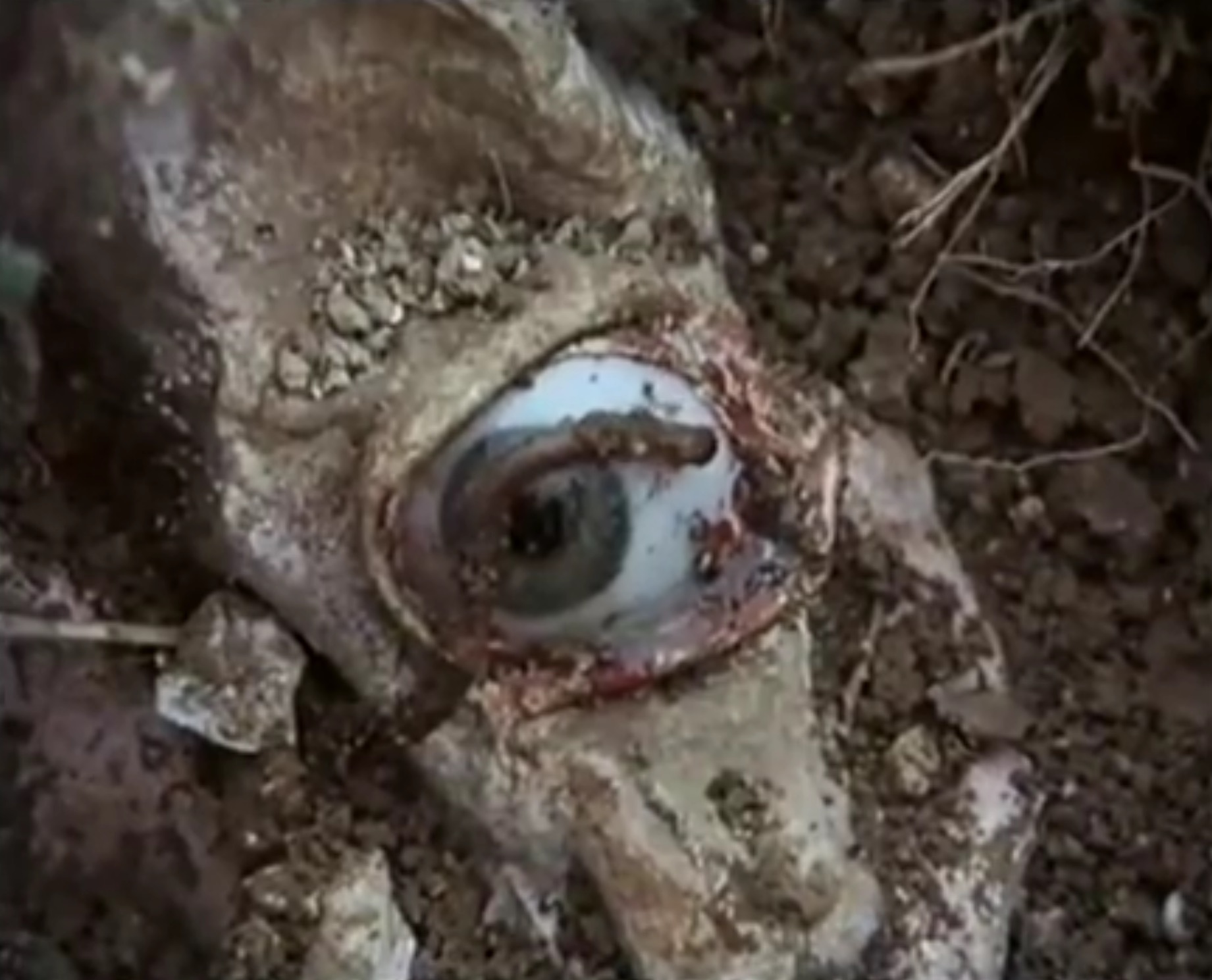
The worm on Satan’s eye.
This isn’t a perfect movie. The music is irritating and often at odds with the mood of the moment. While stalwarts like Patrick Wymark and Anthony Ainley anchor the cast, the many children are of wildly varying ability. The pacing compares unfavorably to glaciers. Yet there is much that works in its favor. Unable to afford the lush sets of richer studios, much of this film was shot in actual locations — locations that, by and large, were cramped and decayed. The dinginess of the movie, the claustrophobic rooms in the open countryside: it all sets a mood of fear and decline that fits nicely into the themes of ancient evil and religio-political upheaval.
The setting of the film is perfect. With the established power structures disrupted by the Interregnum, it’s unclear who can address the contamination of the youth. The local representative of the church is only barely able to resist temptation himself, and the only law presence is a judge who spends most of his time in London and considers the rural people to be ignorant and superstitious. The order of the land has been upset, and evil will make use of the disruption to gain a foothold.
All in all, it’s a nice little apocalyptic movie that shows what can be done within the constraints of a meager budget.
The Return of the Living Dead (1985)
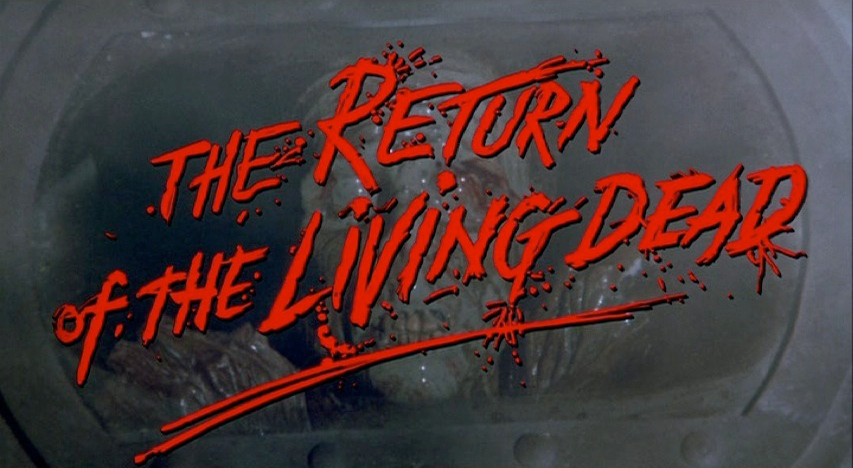
Patient Zero, in a sturdy tank that’s just cracked open.
Written and directed by Dan O’Bannon
Original story by Rudi Ricci, John Russo, and Russell Streiner
Starring Clu Gulager, James Karen, Don Calfa, Thom Mathews, and Beverly Randolph
It’s well-known that Night of the Living Dead is in the public domain because the last-minute title change accidentally removed the copyright notice from the distributed film. It’s less widely known that George A. Romero’s sequels dropped the word “living” from their titles due to the terms of splitting the remaining IP between Romero and co-writer John Russo. While Romero kept the rights to make official sequels, Russo kept the right to use the phrase “living dead”.
It’s a deal that worked well for everyone. Romero, who’d had no attachment to the title their movie had been released under, could explore further dimensions of the setting. Russo could use the title to cash in on the fame of the original work. With a touch of luck, he made some money and launched a new franchise with another film that revolutionized zombies.
The luck took the form of Dan O’Bannon, whose reworked script and directorial vision made The Return of the Living Dead a horror classic in its own right, and a damn funny one at that. O’Bannon had previously contributed to another game-changing film, co-writing Alien with Ronald Shushet. He had collaborated with John Carpenter on Dark Star while in film school. With no credited directorial experience, it’s a wonder that O’Bannon was allowed to helm this project. Again, lucky for the resulting movie that he was.
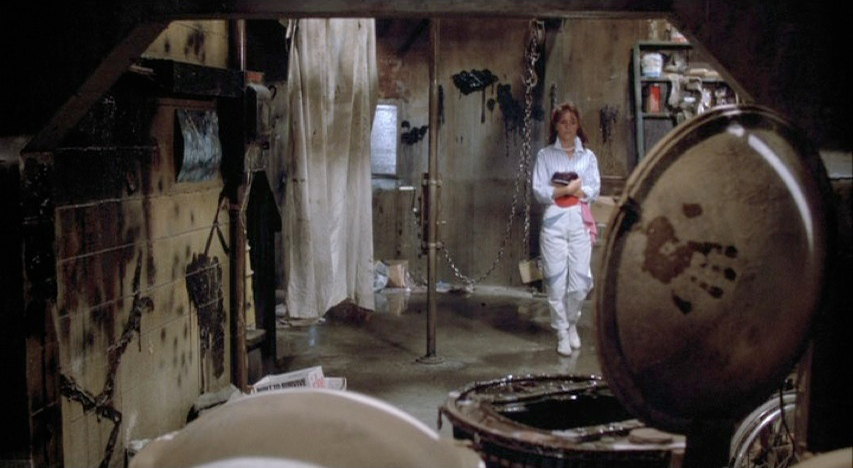
The placement of the handprint where Beverly Randolph can’t see it is a nice touch.
The story is fairly simple. Workers in a medical supply warehouse mess with old canisters misrouted by the US Army. One of the containers cracks, letting out a toxic gas that brings the dead back to life. The warehouse is beside a cemetery, and before too long the entire area is awash in the living dead.
But the story isn’t the whole picture. In fact, as an ensemble piece the story itself depends on which characters you’re following. Many horror films rely on a core group, who are whittled down as they separate. This one has two main groups, who intermix to an extent without ever fully blending. These are the staff of the supply warehouse (along with the embalmer who works nearby) and a group of punks who are friends with the newest employee at the warehouse. What’s brilliant about this is that it allows the veteran actors to anchor the film while including characters that appeal to a younger demographic.

Clu Gulager just wants to dispose of some rabid weasels in the crematorium.
Another smart move was using a punk soundtrack. It had only been a few years since Valley Girl had proven that a film fueled by new wave could move tickets and a single year since the cult film Repo Man used punk songs. It was by no means a safe decision to go with a playlist style of soundtrack at that time, at least not with one that wouldn’t appeal to nostalgic baby boomers a la The Big Chill. Yet it worked, partly because the songs added to the sarcastic tone of the movie, but also because clever selections and editing made the music serve as a score. To this day I can’t hear The Cramps’ “Surfin’ Dead” without envisioning survivors running every which way to broad up windows, and “Burn the Flames” by Roky Erickson makes an eerily somber accompaniment to self-immolation.
The best idea kept from Night of the Living Dead is one of Romero’s recurring themes: every attempt to control the situation makes it worse. There’s a number printed on the canisters to notify the Army about their location. Burt, the owner of the warehouse, decided against calling it when the shipment arrived years ago, likely because of an aversion to getting involved in a bureaucratic snafu. Once the gas leaks, he again dismisses the notion of calling the number as it would lead to an investigation and possible criminal charges. He decides they can handle it themselves, and by “handle” he means “cover up”. So the evidence is taken to the mortuary for burning. Problem solved, except that the smoke has seeded clouds with the reanimation agent 2-4-5 Trioxin. This awakens the dead of the Resurrection Cemetery, creating a situation that spirals quickly out to f control as well-meaning paramedics and police provide more fuel for the fire. It’s all so avoidable, yet completely inevitable, that you have to laugh cynically. One businessman took out at least a large portion of Louisville, Kentucky, because he didn’t want to deal with red tape.
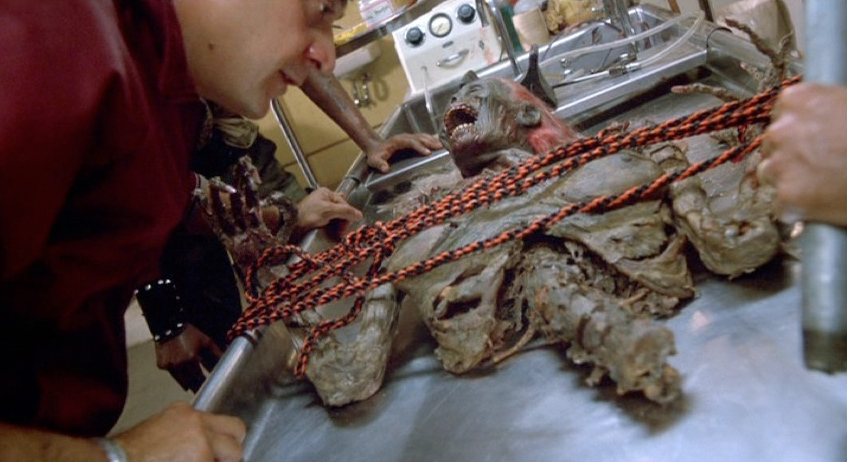
Don Calfa interrogates a zombie.
The Return of the Living Dead is credited with creating and/or popularizing a number of additions to film zombies. Unlike Romero’s undead ghouls, O’Bannon’s ate only brains. They could run, although the more intact corpses were better at it. They could speak, which is still fairly uncommon. The most unnerving part, though, is that they could feel. That’s their entire motivation. It hurts to be dead, and eating brains relieves their suffering for a time. To be consciously dead, aware of your body decaying, and knowing that there is no way to recover — it’s a nightmarish concept that is all too real for sufferers of terminal diseases. The greatest choice O’Bannon made was to make his zombies sympathetic. They are also victims in this film where the enemy is the failure of systems to incorporate human behavior.
¿Quién puede matar a un niño? (1976)

Who Can Kill a Child?
Witten and directed by Narciso Ibáñez Serrador
Based on the novel El Juego de los Niños by Juan José Plans
Starring Lewis Fiander and Prunella Ransome
Stop me if you’ve heard this one before. Tourists seeking an “authentic experience” go to a remote location where they discover that the natives are murderous. Or maybe this one: quite suddenly humanity faces danger from a previously harmless source. How about a woman is faced with the contamination of the child still in her womb.
At its best, ¿Quién puede matar a un niño? is a genre-masher that draws together elements of eco-horror, colonialist terror of uncivilized areas, and generational fears into a fairly unique mixture. At its worst, it is a dull affair that largely consists of two people wandering around a small village while children grin. There’s a lot of footage dedicated to watching people walk around, not finding anybody.
The premise is summarized by the lone surviving adult that our tourists (Tom and Evelyn, from England) find on the Spanish island of Almanzora. He reveals that two nights ago, at midnight, the children went into all of the houses and killed the adults. Nobody could stop them because “¿Quién puede matar a un niño?” (“Who can kill a child?”). It’s a concept that seems pleasantly naïve today. As the news shows us, plenty of people can kill children, and they do. The movie even tells the audience up front that children often suffer and are killed, as a narrator chronicles massive child casualties in conflicts of the mid 20th century. Germany, India and Pakistan, Korea, Vietnam, and Nigeria are discussed in order to hammer home the point: children are killed.

Red rover, red rover, send an adult over!
Here’s where we enter the realm of eco-horror. Just as the birds and the bees in other films, the children have had enough and spontaneously arisen in revolt against humanity — adult humanity anyway. Just as similarly, there is no cause provided for the sudden shift to aggression. It just happens. There is some evidence that the behavior is transmitted from child to child by proximity. In a chilling scene, the English couple find an isolate house on the far side of Almanzora. There are four children playing outside, but their mother and grandmother are fine and unafraid. Tom negotiates for a ride to the mainland once the men return from fishing, but he and Evelyn keep a nervous eye on the children. When two boys arrive from the village, the normal children run over to greet them. Much intense squinting follows, after which all of the children take on a predatory air.
Perhaps the most unnerving thing about the film is that the children are not relentless until they’ve decided to kill again. They giggle and run and play. Of course the clothing the girls dress up in has blood stains, and the boys are excitedly removing the clothing from a dead woman, and they use a body as a piñata. Just like normal children. Evelyn and Tom have several interactions with the children of Almanzora that don’t involve stabbing or chasing. After all, to the children it’s a game, and what’s more fun than letting the prey believe it’s running loose? As long as they don’t get close to the exit.
Planet of the Vampires (1965)

Directed by Mario Bava
Written by Mario Bava, Alberto Bevilacqua, Callisto Cosulich, Antonio Román, and Rafael J. Salvia
Based on the story “One Night of 21 Hours” by Renato Pestriniero
English version written by Louis M. Heyward and Ib Melchior
Starring Barry Sullivan, Norma Bengell, and Ángel Aranda
A crew of space travelers investigating a signal of unknown origin land on a murky planet, where they fall prey to an unknown stalker. Oh, and there’s an ancient alien craft populated by giant skeletons. Sound familiar?
It’s impossible to watch Planet of the Vampires without thinking that it greatly influenced Alien. Not just the high-level plot similarities, or the probable coincidences such as U-shaped spacecraft, but what really strikes you is the creative emphasis on creating a style-driven science-horror experience. It’s just that those styles couldn’t be more different.
Where Ridley Scott choose claustrophobic darkness, Mario Bava elected for bright openness. The bridge sets of the investigating travelers are ludicrously cavernous. The only trace of the creatures preying on the crew are fleeting glimpses of glowing light in a landscape of mists and garish hues. The result is an eerie fantasy world that looks amazing, but unfortunately it’s too ethereal to believe in.
The place where it works best is in the least necessary part of the movie. The interiors of the derelict craft are cramped, especially for the giants that used it. Strange equipment lies everywhere, and attempts to use it activate electric shocks, unintelligible recordings, and the bulkhead door — leading to a panicked effort to reopen it and escape. It’s a terrifically moody scene, and although it lends to the atmosphere and verifies that this planet is a trap, it’s a mostly superfluous diversion from the main story.
It’s got to be humiliating to be caught by a dead guy.
It’s a neat movie, and I adore it, but I’m afraid it’s not very good. The dubbing is never great and is often downright silly. While there’s a lot of visual interest (the costumes and some of the set designs are nifty), there are many times in which it’s painfully apparent that you’re looking at cardboard with a lick of paint. If you like style over substance — and when it comes to Italian cinema, I most definitely do! — then it can be a rewarding view.
One more note: if you’re expecting vampires, you will be frustrated and potentially aggrieved. The vampires exist solely in the minds of whatever marketing team came up with the American title. The original name was the less inaccurate Terrore nello spazio, or Terror in Space. There are some corpses that walk around. They aren’t exactly zombies, but they certainly aren’t vampires. Thank the marketing team at AIP for the misleading title. So now you know.
Opera (1987)
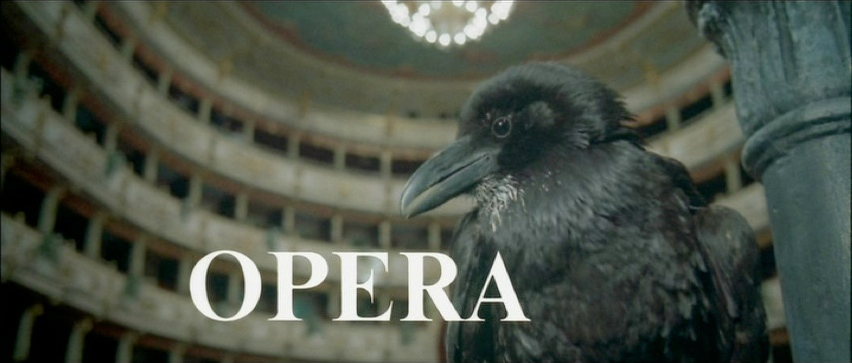
Quoth the raven “Argento”.
Directed by Dario Argento
Written by Dario Argento and Franco Ferrini
Starring Cristina Marsillach, Ian Charleson, and Urbano Barberini
I’m a Dario Argento apologist up to a point, and that point is his 1998 adaptation of The Phantom of the Opera that starred his daughter Asia and Julian Sands. That’s the point in his career where I throw up my hands and say that Susperia is terrific. Fortunately Opera falls in the defensible years by a safe distance; and if it seems ludicrous to hinge a plot on a vengeful raven identifying the killer, just remember that a chimpanzee avenging Donald Pleasence is not the most insane part of Argento’s previous film Phenomena.
Opera is heavily influenced by Leroux’s The Phantom of the Opera, without quite being an adaptation. There’s a young understudy (Betty, played by Cristina Marsillach) who gets the starring role when the prima donna is injured. There’s a mysterious killer, fixated on the ingénue. A performance is interrupted for the penultimate confrontation. The rest is a wild departure, as it is more of a slasher movie than a Gothic romance.
It’s a pretty good slasher, too. The killer strikes those near Betty, binding her so that she is forced to watch. There’s a reason for this fixation, and it’s honestly a tad contrived, but what I love about the film is the way that sight and voyeurism are emphasized by the camera. From the opening shot of a closeup of a raven’s eye, the lens is fixated on p.o.v. shots, eyes, and focusing the view through narrow spaces.
The ravens and Betty have seen things that we haven’t, and fittingly it’s what Betty doesn’t recall having seen that explains her importance to the killer. Further, it’s what she can’t see when her stalker finally blindfolds her that nearly kills Betty.

Not what you want to see through your peephole.
For all of the above I adore Opera. Even the choice of an opera based on Macbeth fits thematically, as not only is the play believed to be cursed but Lady Macbeth’s most famous scene is wrapped up in guilt for bloody deeds. This is a bit of a nod to the film’s back-story.
Here I’m just going to say it, so if you really don’t want to know the reveal for a movie nearly 30 years old, skip to the next paragraph. Betty’s mother made the killer torture and kill young women. Betty herself had seen it happen as a child but had repressed it, because repressed memories are a terrific substitute for good writing. So, the mother’s actions ate transferred to the daughter to expiate the killer’s guilt. Thus, Betty plays Lady Macbeth.
Anyway, it’s definitely a flawed movie. The pins under Betty’s eyelids are a good visual but infeasible as presented. The bit with the ravens is well-filmed but downright silly. I don’t even want to know who thought dubbing a creepy adult for a young girl was a good plan. The play’s director being a clear stand-in for Argento and making moves on his much younger star is downright gross.
Yet this is the Argento I prefer to remember. The one who put effort into artistic touches that rise above the material; not the one we have now, cashing in on what’s left of his reputation with artless cheapies where the main attraction is his own naked daughter.
Nekromantic (1987)

All due props for the nifty font work.
Directed by Jörg Buttgereit
Written by Jörg Buttgereit and Franz Rodenkirchen
Starring Bernd Daktari Lorenz, Beatrice Manowski, and Harald Mundt
I don’t know why I bought Nekromantic. I don’t have any desire to watch simulated necrophilia, and I’d never heard anyway say they enjoyed the film. Actually, all I’d ever heard was rear it was an infamous entry on the British “video nasties” list. There’s a lot of reasons that something would be put in that company, and this was reputed to have essentially used those as a checklist. Maybe it was morbid curiosity then that made me shell out an unreasonable amount for the blu of this.
Since Nekromantic deals with necrophilia, murder, and rape, I’m going to give the weak of stomach an opportunity to bail out now. Also, if a pet kill is an automatic deal-breaker for you, you really don’t need to read any more. Additionally, if seeing a real rabbit killed, bled, and skinned repels you, move on. I think that covers the worst of it. Unless caterpillars freak you out, I guess. Oh, and shots of urination. And ejaculate from a fake penis.
My biggest problem with this movie is that what I listed above is all there is to it. It’s just an exercise in transgression. That’s fine, and if you’re into watching people bathe in corpse drippings then it’ll provide that. But in between shocks, there’s a nothingness that’s occupied by overlong establishing sequences and seemingly endless repetition of the rabbit footage. Anything to stretch the run time to a paltry 75 minutes.
Here’s the story, and I’m telling every important part of it. Rob and Betty love dead things. Rob brings dead bits home from his job at Joe’s Streetcleaners. One day he brings home a decayed body, which becomes Betty’s favorite sex toy. When Rob is fired, Betty leaves with the corpse. Rob can’t get it up with a prostitute until he rage kills her. Rob stabs himself to death in a sexual frenzy. Betty starts to dig up his body.

The wall hanging that doubles as a sex toy.
The dead space is filled with nothing meaningful. There are two tedious scenes about how people became bodies for Rob to clean up. There are numerous scenes of Rob dreaming of cavorting in a field. Rob goes to a horror movie, where he sees people getting aroused by the sexual violence. Some of this film spackle could have been interesting if it had been better written. The audience reactions fit in with a show that Rob had watched about desensitization, but so what? If that had anything to do with Rob’s state, that happened a long time before the start of the movie.
The dullness of these stretches leaves the viewer plenty of time to think about what be better. Like making an actual connection between the rabbit and, well, anything. Showing an actual progression in Rob’s behavior. In extremely quick order he goes from killing one animal to killing a person; but he since he seems capable of all of that from the beginning, where’s the change?
It seems a bit misplaced to expect narrative quality out of a movie that features a love scene of a corpse performing fungilingus on the female lead, but I really don’t ask for Oscar quality work here. Go ahead and nauseate me, push me why the hell out of my comfort zone, but don’t leave me bored while waiting for the next shock.
El Monstro del Mar! (2010)

There’s a pre-credit scene of them cleaning the blood off this car.
Written and directed by Stuart Simpson
Starring Nelli Scarlet, Kyrie Capri, and Norman Yemm
Following a bloody heist, three bad girls hide from the law in a tiny fishing village. There they clash with a wheelchair-bound old man, who is raising his teenage granddaughter with no visible means of support. It sounds like the premise of a Russ Meyer homage, and apart from the titular monster that’s pretty much what the film delivers.
The majority of the film deals with the interactions between the women in hiding, led by Beretta (Nelli Scarlet), and the sheltered Hannah (Kyrie Capri). It’s an awkward relationship from the start. The criminals view Hannah as a naive yokel to toy with, while she sees them as intriguing but reckless. After one drunken night together, Hannah has had enough to know that their life is not for her, yet neither was her own. For Hannah then the story is about growing into her own person. For Beretta it becomes about revenge.
This is a monster movie, so while all the human drama transpires along the shore a sort of giant squid emerges from the deeps. The fishermen of the small community are wiped out over the course of a night and a day, and one of Beretta’s gang falls victim as well. Before you can say “tell us what’s in the water” it’s women versus cephalopod. The monster has snapping jaws on its tentacles. The women have whatever they can find in a fishing shack.
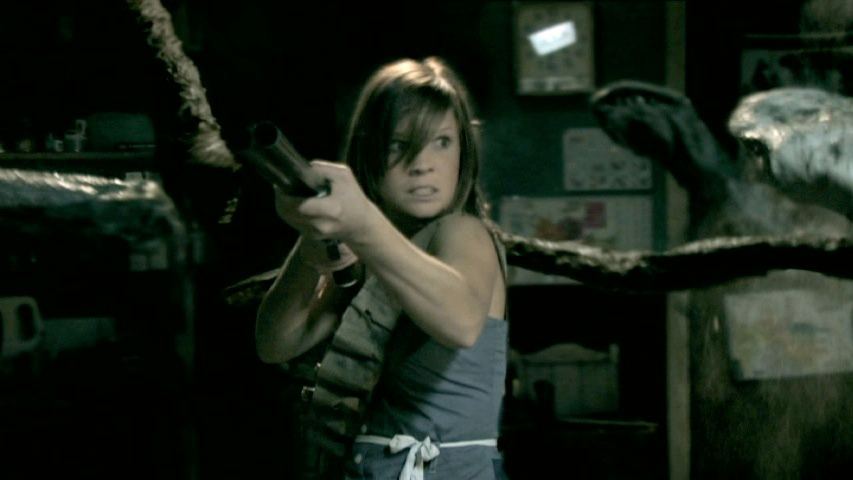
Hannah has never been confronted with so Freudian a threat.
I had a lot of fun with one. I’ve seen El Monstro del Mar! three times now, and I like it a little more with each viewing. Of course, I am pretty much its target audience; being a fan of monster flicks, practical effects, and cheesy sleaze. There’s a lot of leering camera angles, homoeroticism, and other PG titillation you’d get in the average Katy Perry video. The lighting and makeup are less flattering, however, giving a raw low-budget feel that makes everything look dirty and used.
The creature effects range from pretty admirable to endearingly silly. The exterior shots of the monster mounted atop the fishing shack is hilarious, in a good (and hopefully intentional) way. The majority of what is shown of the monster are its tentacles. It’s a wise choice, and the small array of credited puppeteers shows the filmmakers were committed to making it work for them. Indeed, the seemingly endless tentacles make the finale a thrilling, non-stop struggle. It’s a hell of a finish, and the fight itself wraps up all of the plot threads.
When a monster movie remembers to tell a solid story in between killings, it makes it a lot more enjoyable to wait around for the full reveal of the monster. It doesn’t take a lot to give characters purpose and conflict, but so often all we’re given is the same handful of kids looking to party, whose only conflict is (to quote the porn version of Hamlet) “to fuck or not to fuck”. Centering the story on a young woman befriending a trio of killers gives El Monstro… a light cake for its monster frosting to cover. But more appetizing than that sounds. Squid frosting… just, no.
 Web of the Big Damn Spider
